

How Long to Rewire Brain From Addiction and What to Expect?
Rewiring your brain from addiction is not a single event that happens at a fixed date.
Research shows that meaningful brain recovery often begins within days to weeks of stopping substance use, with many core cognitive functions improving substantially within 6 to 12 months of abstinence.
This article walks through what the science actually says about how long it takes to rewire your brain from addiction, what changes at each stage, and what shapes your personal timeline.
How Long to Rewire Brain From Addiction: The Core Answer
The brain does not reset on a 30-day or 90-day clock. A systematic review of 45 longitudinal neuroimaging studies found that structural recovery appears most consistently in the frontal cortex, insula, hippocampus, and cerebellum during abstinence.
Neurochemical changes begin soon after stopping, especially with alcohol, while functional recovery tends to take longer.
A separate systematic review of 16 longitudinal studies in adults with alcohol use disorder found that most neuropsychological functions, including attention, memory, perception, and executive skills, recover within 6 to 12 months.
Some simpler processes like basic processing speed recover earlier. Higher-order reasoning shows less consistent recovery.
The most honest, evidence-based answer is this: the brain usually begins recovering within days to weeks, shows meaningful change over 3 to 6 months, and undergoes major cognitive and neurobiological recovery over 6 to 12 months and beyond.
Complete normalization is not guaranteed for every system or every person, but it is also not required for a successful, lasting recovery.
What “Rewiring” Actually Means?
The phrase “rewire your brain” is common but scientifically loose. In practice it refers to several overlapping processes happening at different speeds:
- Structural recovery: changes in gray matter volume, cortical thickness, and white matter integrity
- Functional recovery: shifts in how brain networks activate, connect, and respond to cues
- Neurochemical recovery: partial normalization of dopamine and other neurotransmitter systems
- Neuropsychological recovery: improvements in memory, attention, processing speed, and executive function
- Clinical recovery: reduced craving, better mood, lower relapse risk, and improved daily functioning
These processes do not move in lockstep. Someone may show early structural improvement on a brain scan while still experiencing strong cue-triggered cravings and emotional instability.
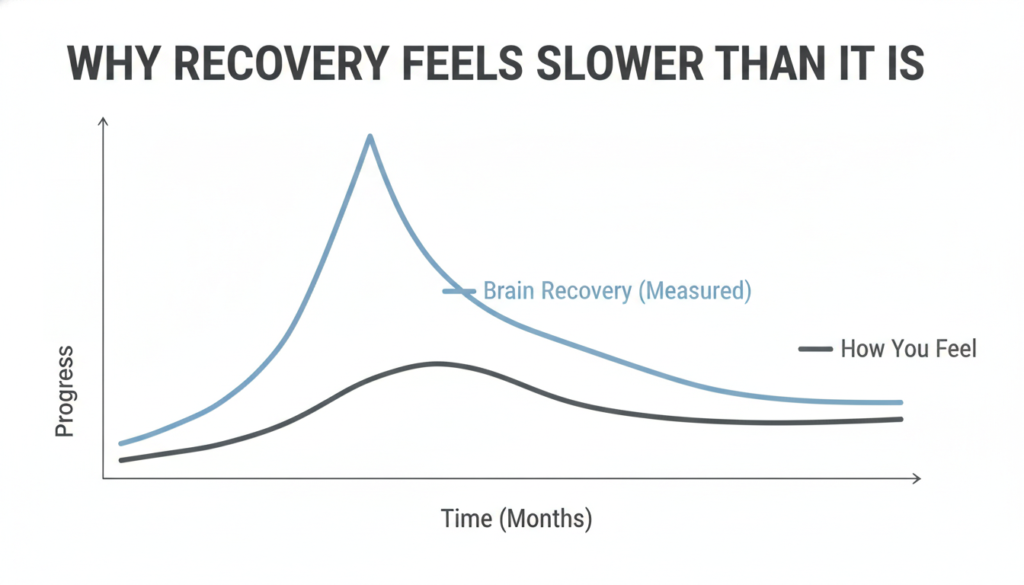
That gap between visible repair and full functional recovery is one of the most important things to understand about how long it takes to rewire your brain from addiction.
A Stage-by-Stage Timeline of Brain Recovery
Days to a Few Weeks
The brain starts changing almost immediately after stopping substance use. Neurochemical adaptation begins early, particularly in alcohol-related recovery.
At the same time, this phase is often the hardest. Withdrawal symptoms, sleep disruption, emotional volatility, and cognitive fog are common.
Research on sleep abnormalities in early abstinence shows that poor sleep during this period can impair attention, memory consolidation, and emotional regulation, all of which slow apparent recovery.
Increased sleep latency in the first two weeks of alcohol abstinence has been linked to higher relapse risk over the following five months.
This is not the stage to expect clarity or steadiness. The brain is changing, but it is still highly destabilized.
One to Three Months
Basic processing speed and working memory updating tend to improve earlier than higher-order functions.
Some functional changes in reward-related brain regions have been observed within this window, though the evidence is thinner for non-alcohol substances.
Clinically, mood often starts improving during this period. A 2025 study tracking anxiety and depression trajectories in people with alcohol use disorder found that many individuals show rapid early improvement in the first month.
However, a clinically important subgroup does not improve quickly, and sustained symptoms signal higher relapse risk and a need for more tailored care.
People often feel noticeably better during this phase and may overestimate how recovered they are. Frontal control under stress may still be weak even when day-to-day mood has lifted.
Three to Six Months
This is the phase where the phrase “the brain is rewiring” starts to match lived experience more closely. Structural recovery in frontal regions and white matter continues.
Some EEG markers associated with relapse risk begin to shift. Executive control improves, and cue-triggered responses may become less intense.
A scoping review of 44 EEG studies in substance use disorder treatment found that abstinence was associated with decreases in cue-elicited brain responses and reductions in resting beta power, both markers linked to recovery and reduced relapse risk.
Three to six months is best understood as major progress, not completion.
Six to Twelve Months
This is the core neurorecovery window supported by the strongest direct evidence. The 2024 longitudinal systematic review in alcohol use disorder found that most neuropsychological functions, including attention, executive function subdomains, perception, and memory, recover within this period.
The neuroimaging review similarly found that structural and functional stabilization continues across the first year.
Structural improvements correlate with better cognitive performance, meaning the brain changes visible on scans likely underpin real improvements in thinking, planning, and emotional regulation.
If someone asks when many of the cognitive benefits of abstinence typically become clear, 6 to 12 months is the strongest evidence-based answer for alcohol-related recovery, and the broader pattern likely applies across substance types.
Twelve Months and Beyond
Recovery continues after the first year. Some reward and control systems keep normalizing. Emotional regulation becomes more consistent.
Coping skills become more habitual. However, some deficits may persist, particularly in people with polysubstance use histories, psychiatric conditions, or prolonged and severe exposure.
The literature supports continuing recovery after 12 months while also recognizing that some individuals show persistent residual changes.
That is not a reason for pessimism. Successful long-term recovery does not require every brain system to return to a pre-addiction baseline.
How Long Does It Take for Dopamine Receptors to Recover?
This is one of the most searched questions in addiction recovery, and it deserves a direct answer.
Dopamine receptor recovery is not a simple reset. Research shows that detoxified people with alcohol use disorder can have profoundly blunted dopamine release in the striatum even after physical withdrawal ends. Stimulant use is associated with reduced dopamine receptor availability and blunted release capacity. These changes do not reverse overnight.
In practical terms, the dopamine-related symptoms people notice most are anhedonia (reduced pleasure), low motivation, and emotional flatness.
A narrative review of anhedonia across substance use disorders found that anhedonia tends to improve over abstinence, and one cited six-month follow-up study of opioid-dependent patients found that elevated anhedonia reduced to near-normal levels after about 1 to 2 months in people who did not relapse.
That is one of the most concrete data points available. Pleasure often starts returning within the first month, but full motivational recovery commonly takes several months and may remain incomplete in some people, especially after heavy or prolonged use.
The key insight is that dopamine receptor recovery is not a single biological event. It is a gradual functional normalization of reward circuitry, and it is shaped by abstinence duration, sleep quality, psychiatric health, and treatment engagement.
What Slows or Speeds Up Brain Recovery?
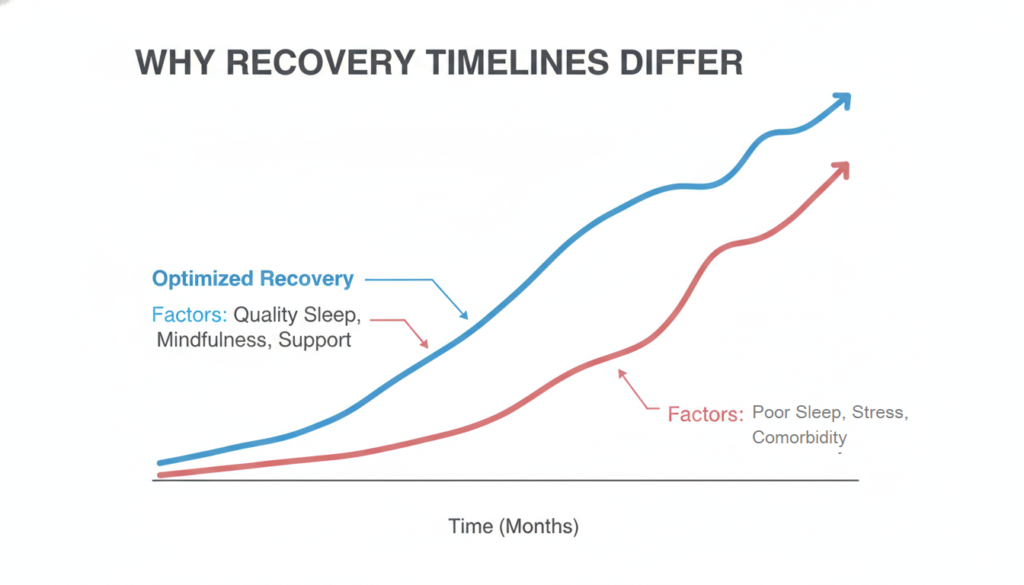
Recovery time is not the same for everyone. Several factors consistently appear in the research as meaningful moderators:
- Polysubstance use: People who have used multiple substances show slower and less complete cognitive recovery. Even after one year of abstinence, polysubstance users may show lower cognitive function than controls.
- Psychiatric comorbidity: Depression, PTSD, ADHD, and personality disorders can amplify brain dysfunction and slow recovery. A 2025 neuroimaging review found that schizophrenia and personality disorder may amplify neurobiological effects of substance use, while depression may attenuate or have no additional effect.
- Smoking: In a prospective study of 129 people with alcohol use disorder followed for 18 months, smokers relapsed earlier and a greater proportion relapsed within six months of treatment.
- Sleep quality: Poor sleep during abstinence impairs cognition and predicts worse outcomes. Persistent insomnia can materially slow apparent brain recovery even in people who remain abstinent.
- Brain morphology at treatment entry: Volumes of the right caudal anterior cingulate cortex and total right frontal gray matter predicted drinking status at 18-month follow-up in the same relapse study.
- Age and developmental stage: Adolescence is a sensitive neurodevelopmental period. Early intervention matters more, and the consequences of use during development may differ from adult-onset use.
- Treatment engagement: Psychosocial treatments support abstinence, which is the main condition under which recovery occurs. The brain does not rewire through passive waiting alone.
Why Frontal Recovery Matters Most?
Across neuroimaging, cognition, and relapse research, the frontal cortex appears repeatedly as both a primary site of addiction-related change and a key target for recovery.
The prefrontal cortex supports response inhibition, planning, and salience attribution, all of which are central to the addiction cycle.
When frontal systems recover, people typically notice improvements in impulse control, future-oriented thinking, resistance to cues, and the ability to engage meaningfully with treatment.
That is why the 6 to 12 month window feels so different from the first few weeks for many people in recovery.
What Recovery Actually Feels Like Over Time?
Understanding the neuroscience is useful, but it helps to translate it into what people actually experience:
- In the first weeks, most people feel worse before they feel better. Fog, irritability, poor sleep, and strong cravings are normal and do not mean recovery is failing.
- By one to three months, many people notice clearer thinking and some improvement in mood, though emotional instability under stress often remains.
- By three to six months, day-to-day functioning often improves noticeably. Cravings may become less constant, though cue-triggered urges can still be strong.
- By six to twelve months, many people describe feeling more like themselves. Memory, concentration, and emotional regulation are often substantially better.
- Beyond twelve months, gains tend to consolidate. Residual vulnerabilities may remain, but the tools and stability to manage them are usually stronger.
This is not a linear path. Relapse can reverse gains. Stress, poor sleep, and untreated psychiatric symptoms can stall progress.
But the research is clear that the brain has a real capacity to recover, and that capacity is most active during the first year of sustained abstinence.
The Role of Treatment in Brain Recovery
Treatment does not just support sobriety. It creates the conditions under which the brain can recover. Abstinence is the substrate for neurobiological change, and anything that extends and stabilizes abstinence also extends the window for recovery.
Behavioral treatments, particularly contingency management, show strong evidence for supporting abstinence in stimulant use disorders where dopaminergic reward is most blunted.
Cognitive support and structured skills training are especially valuable for people with executive dysfunction or polysubstance histories, because their brains may not yet have the processing capacity to benefit fully from insight-based therapies alone.
The practical implication is that recovery programs should not assume cognitive normalization in early treatment. Supporting thinking, sleep, mood, and structure during the first year gives the brain the best chance to do what the research shows it can do.
If you or someone you care about is navigating addiction recovery and wondering what to expect, speaking with a specialist can help you understand your personal timeline and build a plan that accounts for where you are right now. So, reach out to Mosaic’s addiction treatment team to take the next step.