

How Can Holistic Addiction Treatment Support Recovery?
Holistic addiction treatment addresses the whole person, not just the substance use, and that broader focus can make a real difference in long-term recovery.
The U.S. Department of Veterans Affairs states that complementary approaches may improve recovery outcomes when added to conventional treatment, though they are not meant to replace it.
This article breaks down what holistic treatment actually includes, which approaches have the strongest evidence, and how you can use this information to make better decisions about care.
How Holistic Addiction Treatment Supports Recovery?
Holistic addiction treatment works by expanding care beyond symptom control to address the physical, emotional, social, and behavioral conditions that shape whether recovery lasts. A person with opioid use disorder or alcohol use disorder is rarely managing cravings alone.
They may also be dealing with insomnia, chronic pain, trauma, shame, depression, social isolation, and a stress-response system that has been pushed hard for years. Treating only the substance while leaving those conditions unaddressed leaves a lot of relapse risk on the table.
That is the core clinical logic behind holistic care. It does not reject medication or psychotherapy. It builds on them.
What “Whole Person” Actually Means in Practice?
When clinicians talk about treating the whole person, they mean attending to several overlapping dimensions at once:
- Physical health, including sleep, nutrition, exercise, and withdrawal-related discomfort
- Psychological health, including coping skills, craving awareness, and relapse triggers
- Emotional health, including trauma, anxiety, shame, and the ability to tolerate difficult feelings without using
- Social health, including relationships, peer support, family involvement, and community connection
- Behavioral health, including daily routine, self-care habits, and lifestyle structure
- Values and meaning, including purpose, identity, and motivation to stay in recovery
A 2025 systematic review on emotional regulation in addictive disorders found that the ability to manage difficult internal states is a central treatment target across substance use disorders.
Many people use substances not for pleasure alone, but to numb trauma, reduce anxiety, escape shame, or blunt depression. Holistic approaches that build non-drug ways to regulate those states are addressing something real and clinically important.
Holistic Treatment is an Addition, Not a Replacement
This point matters enough to state plainly. Holistic addiction therapy is most defensible when it sits on top of evidence-based care, not instead of it. For opioid use disorder, medication-assisted treatment remains first-line.
A review of pharmacological and behavioral treatment for opioid use disorder is clear that medication should be provided alongside counseling and behavioral interventions, not replaced by wellness practices.
Steering someone away from buprenorphine or methadone toward yoga and nutrition alone is not a holistic approach. It is a dangerous one.
The same logic applies to alcohol use disorder. Medically supervised detoxification is essential when withdrawal risk is present. Holistic practices belong in the stabilization and recovery maintenance phases, not as substitutes for medical safety.
Which Holistic Therapies Have the Strongest Evidence?
Not all holistic modalities are equally supported by research. Here is an honest look at where the evidence stands.
Mindfulness and Mindfulness-Based Relapse Prevention
Mindfulness-based relapse prevention, known as MBRP, is the most evidence-supported holistic modality in addiction care. It was developed specifically for substance use disorders and combines mindfulness meditation with cognitive relapse-prevention skills.
It is designed for people who have completed initial treatment and want to maintain recovery and make lasting lifestyle changes.
A meta-analysis of mindfulness-based relapse prevention found that MBRP can improve some relapse-related outcomes, reduce depressive symptoms, and lower craving-related measures, with variation across populations and substances.
A systematic review of manualized mindfulness programs documented multiple studies across alcohol, opioid, stimulant, smoking, and residential treatment populations, reinforcing that the evidence is promising though still mixed in places.
Mindfulness appears especially useful for:
- Craving awareness and urge surfing
- Stress reactivity and emotional regulation
- Negative affect and depressive symptoms
- Relapse prevention after stabilization
A 2021 review of mindfulness-based interventions for substance use disorders, including the landmark Bowen et al. trial comparing MBRP with standard relapse prevention and treatment as usual, reinforces that mindfulness is one of the few holistic approaches with replicated, peer-reviewed support across multiple substance categories.
Yoga
Yoga has a smaller but growing evidence base in addiction treatment. One randomized controlled trial found that yoga improved mood and quality of life in women undergoing heroin detoxification.
A narrative review covering 16 studies, 12 of them randomized controlled trials, found positive signals but also noted small sample sizes, heterogeneous populations, and limited long-term outcome data.

Yoga is most plausible as a support for stress reduction, body awareness, autonomic regulation, and sleep, especially for people with trauma-related dysregulation or high physical tension.
It is a reasonable adjunct, particularly when patients want it, but claims that yoga alone treats substance use disorder are not supported by the current evidence.
Exercise
Exercise has a broader evidence base in behavioral medicine and a growing one in addiction. Studies in abstinent methamphetamine-dependent individuals in residential treatment found that exercise improved depression and anxiety symptoms.
A meta-analysis found that physical exercise has a beneficial effect on substance use disorders, though the mechanisms and outcome specificity vary.
Exercise supports mood, routine, natural reinforcement, and physical health restoration, making it one of the more credible and low-risk holistic components.
Massage Therapy
The VA notes that massage may help with relaxation, muscle tension, anxiety, and symptoms of withdrawal from alcohol, cocaine, and opiates, citing preliminary evidence.
Massage is not a primary addiction treatment, but it may support recovery in early stabilization by lowering somatic arousal and making treatment more tolerable.
Better tolerability can support retention, and retention matters for outcomes.
Acupuncture
Acupuncture is common in holistic programs but the evidence is more cautious than many provider websites suggest.
A systematic review and meta-analysis including 41 studies and over 5,000 participants found no consistent differences between acupuncture and comparators for relapse, frequency of use, or dropout.
There were short-term effects favoring acupuncture for withdrawal-related craving and anxiety, but those findings were limited by publication bias and did not hold at longer follow-up.
Acupuncture may be a reasonable comfort-oriented adjunct for selected patients, but it should not be presented as a core anti-addiction therapy.
Why is Emotional Regulation Central to Holistic Recovery?
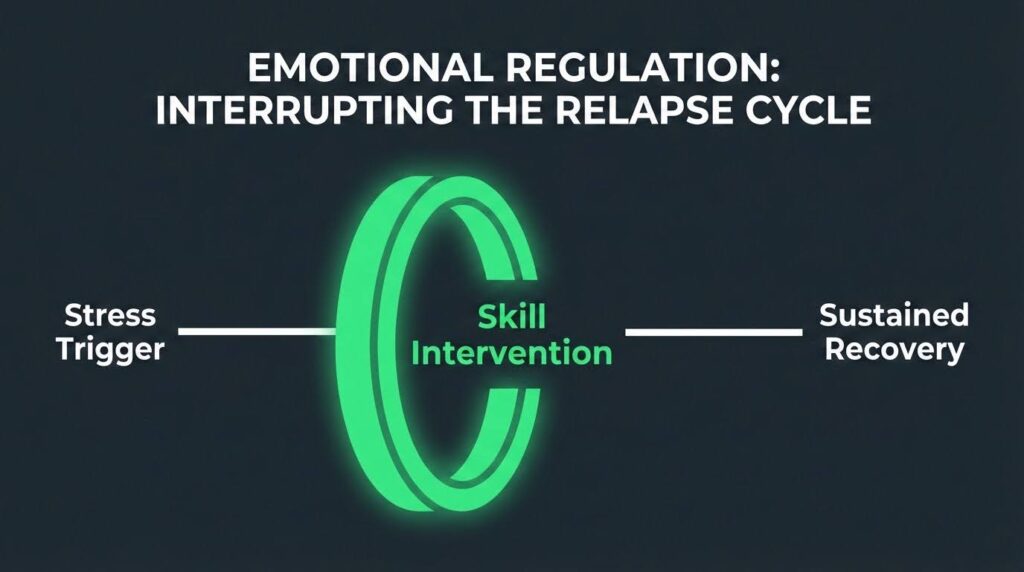
One of the clearest findings across the research is that emotional regulation sits at the heart of addiction and recovery.
The 2025 systematic review on emotional regulation in addictive disorders shows that interventions incorporating mindfulness, emotion regulation training, and related skills are relevant to cravings, distress tolerance, and psychiatric symptoms across substance use disorders.
This helps explain why holistic practices that target stress reactivity and self-regulation can be clinically useful.
When someone learns to notice a craving without automatically acting on it, or to sit with anxiety without reaching for a substance, they are building a skill that directly reduces relapse risk. That is not peripheral to recovery. It is central.
Stress is also a major relapse driver. Holistic practices that calm the nervous system and strengthen coping may improve resilience in ways that complement what medication and psychotherapy do.
The mechanisms are consistent with what the peer-reviewed mindfulness and emotional-regulation literature describes.
The Role of Social Connection and Recovery Capital
Holistic recovery is often described in individual terms, but the deeper research shows that social and environmental factors are equally important.
Recovery capital refers to the internal and external resources that support a non-using life, including social support, housing, purpose, skills, health, and community connection.
Research on long-acting injectable buprenorphine found that medication works best when embedded in recovery-oriented systems with psychosocial support and community partnerships.
That finding applies broadly. Even the most effective pharmacotherapy benefits from a surrounding structure that supports identity change, social belonging, and reduced stigma.
Some holistic practices support this transition indirectly. Meditation groups, yoga classes, peer-led wellness programs, exercise routines, and service work can help people inhabit a new identity, build sober social networks, and find communities organized around wellness rather than substance use.
These are not substitutes for addiction treatment, but they can make recovery more livable and more socially anchored.
What a Credible Holistic Addiction Program Looks Like?
A well-designed holistic program does not choose between evidence-based care and whole-person support. It combines both. Here is what that looks like in practice:
- A clinical foundation that includes medical assessment, evidence-based psychotherapy, medication treatment when indicated, co-occurring disorder evaluation, and relapse-prevention planning
- Mindfulness-based relapse prevention or structured mindfulness practice as a core adjunct
- Exercise and movement programming to support mood, routine, and physical health
- Sleep and nutrition support to address the physical damage that often accompanies substance use
- Stress-management training and self-care skill building
- Family and peer support involvement
- Recovery-capital and life-function planning to help people rebuild structure and purpose
Programs that market holistic treatment as a stand-alone alternative to medication, psychotherapy, or dual-diagnosis care are not supported by the strongest evidence.
The most defensible version of holistic care is integrated, monitored, and honest about what each component can and cannot do.
A Practical Summary: Evidence by Modality
| Modality | Relative Evidence Strength | Best-Supported Role |
|---|---|---|
| Mindfulness and MBRP | Moderate, strongest among holistic approaches | Relapse prevention, craving awareness, stress and emotional regulation |
| Exercise | Moderate | Mood, routine, physical health restoration |
| Yoga | Low to moderate | Stress reduction, body awareness, autonomic regulation |
| Massage | Low to moderate | Early recovery comfort, anxiety and withdrawal symptom relief |
| Nutrition and sleep support | Moderate for general health | Physical restoration, energy, medication tolerance |
| Acupuncture | Low, mixed findings | Short-term symptom relief, comfort adjunct |
| Expressive therapies | Low direct SUD evidence | Engagement, emotional expression, identity support |
Why This Matters for Long-Term Recovery?
The strongest addiction research does not support a narrow, episode-based model of care. A RAND systematic review on medication-assisted treatment functional outcomes found that meaningful recovery includes cognitive, physical, occupational, social, and neurological functioning, not only abstinence. Holistic treatment is often aimed at exactly these under-measured but clinically important outcomes.
A 2025 article calling for research on whole-person recovery argues that addiction research has historically overemphasized relapse prevention and immediate proximal mechanisms while underdeveloping models of broader socioecological context. That is a strong argument for holistic thinking, not as an alternative to science, but as an extension of it.
The clearest conclusion from the evidence is this: holistic addiction treatment supports recovery not by replacing standard care, but by making recovery more comprehensive, more tolerable, more regulated, and more sustainable.
It helps people build a life in which sobriety is biologically, psychologically, and socially maintainable. That contribution is real, but only when grounded in evidence, individualized care, and clinical honesty.
If you are looking for whole-person addiction and mental health care that combines evidence-based treatment with integrated support, consider reaching out to learn more about outpatient addiction treatment at Mosaic.