

Why High-Functioning Addicts Rarely Seek Treatment Until Crisis Hits?
If you are holding your life together on the outside while quietly losing control on the inside, you are not alone!
About 80% of people who needed substance use disorder treatment in 2024 did not receive it, and high-functioning addicts rarely seek treatment because outward success makes concealment easier than care.
This article explains why that delay happens, what keeps it in place, and what can break the cycle before a crisis forces the issue.
Why High-Functioning Addicts Rarely Seek Treatment Early?
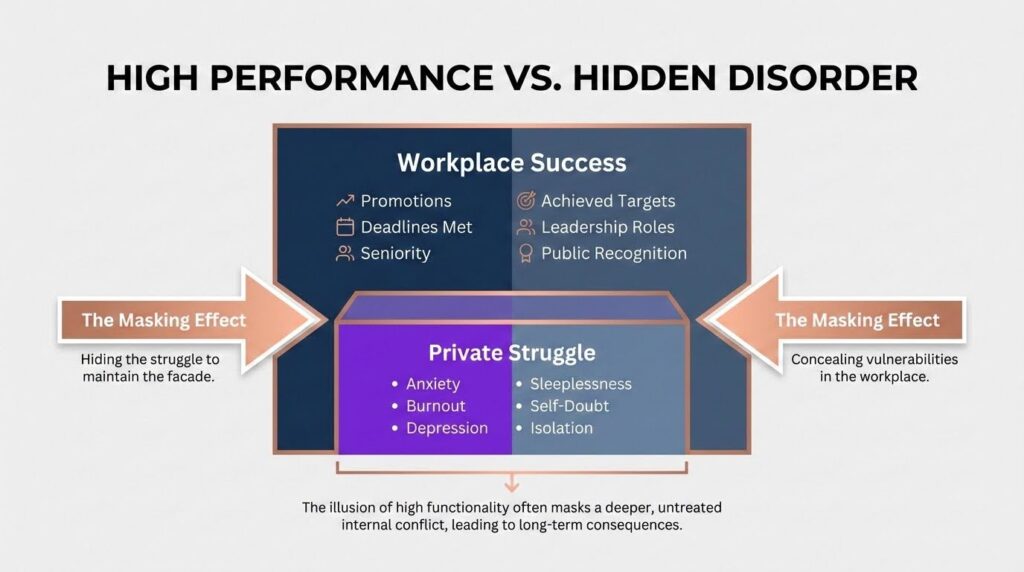
The term “high-functioning addiction” is not a formal diagnosis. It describes a real pattern, though: someone meets deadlines, earns promotions, cares for children, and appears socially polished while privately experiencing clinically significant dependence.
Their productivity does not mean the disorder is mild. It often means the disorder is hidden, subsidized by personal resources, or socially normalized.
The Surgeon General’s report confirms that substance misuse can be reliably identified through screening and that less severe forms often respond to brief physician advice and other early interventions, especially for alcohol.
Early treatment is cost effective. So the question is not whether help exists. The question is why people who still look successful avoid it.
The answer sits at the intersection of denial, stigma, workplace culture, and systems that were never designed to catch someone who is still performing.
How Functioning Masks Disorder and Raises the Cost of Disclosure?
High functioning produces a double effect. First, it masks the disorder. Second, it raises the perceived cost of getting help.
Plausible deniability built on success
A person who still pays bills, holds a title, and shows up on time has visible data supporting the belief that things are under control.
One qualitative study captured this directly: participants said, “I don’t feel like I have a problem because I can still go to work and function.”
The same research found that people who deliberately adjusted use to avoid interference with work responsibilities were less likely to recognize they had a problem at all.
In workplaces where alcohol is woven into networking and celebration, continued performance can coexist with escalating use.
A literature review in Frontiers in Public Health identified alcohol-tolerant workplace environments as a risk factor for misuse and found that demanding job situations were linked with alcohol-related presenteeism.
The stakes of disclosure feel too high
Someone who has built a career and identity around competence may see treatment as a direct threat to reputation, licensure, promotion, financial stability, custody, and self-concept.
As long as outward functioning stays intact, the internal cost-benefit calculation favors secrecy over treatment. A crisis changes that calculation by suddenly making non-treatment more dangerous than disclosure.
Denial in High-Functioning Addiction is Structurally Reinforced
Denial in high-functioning addiction is not simple stubbornness. It is structurally reinforced by the person’s environment and identity.
The “not that bad” trap
High-functioning individuals compare themselves not to healthy functioning but to more visibly deteriorated cases. The logic sounds like this:
- “I have never lost my job.”
- “I don’t drink in the morning.”
- “I’m not getting arrested.”
- “I still show up and win.”
This comparison is partly true, which makes it sticky. But substance use disorder severity does not need homelessness, job loss, or arrest.
The Surgeon General’s report supports screening for risky use before severe disorder emerges, reinforcing that treatment is appropriate well before end-stage collapse.
Yet public stigma continues to associate addiction with catastrophe, making people who have not yet collapsed feel exempt from care.
Identity as an anti-treatment defense
People in high-status roles often experience addiction disclosure not merely as a health event but as an identity threat. Their self-concept may be built on discipline, expertise, reliability, and emotional control.
Admitting need can feel incompatible with their role. Professional-focused clinical literature describes rationalizations such as “If I were an addict, I couldn’t possibly be so successful at work.” That is not arrogance. It is identity-protective resistance to a narrative of impairment.
Barriers to Treatment for High-Functioning Addicts
The barriers are layered and mutually reinforcing. They operate at the individual, social, workplace, and system levels.
Stigma works on multiple levels
Stigma is not one barrier. It is a system. A review of self-stigma and perceived social stigma in treatment-seeking found recurring reports of shame, embarrassment, guilt, and a need for secrecy about both use and treatment attempts.
Among people not seeking treatment, 84% said their problem was not serious and 96% said they could handle it themselves.
Another review found that perceived social stigma and healthcare-provider stigma can increase internalized self-stigma, reduce treatment engagement, and worsen recovery through negative emotions and reduced self-efficacy.
For high-functioning individuals, whose identity is built around being seen as disciplined and in control, these forces are especially strong.
Workplace culture often sustains the delay
The workplace is where most adults spend much of their time, making it both a risk environment and a potential intervention setting. Yet it often fails to function as an early detection system.
High performers may receive more latitude. Their achievements create a halo effect. Supervisors may hesitate to confront them because they deliver results, hold seniority, or are socially influential. Meanwhile, Employee Assistance Programs remain underused.
One industry summary reports that 51% of private-sector employers offer EAPs covering more than 67 million employees, yet the average utilization rate is around 5%.
Employees may not trust employer-linked support. They worry that using behavioral health resources will affect promotion, trust, assignments, or job security. Where confidentiality is uncertain, treatment delay is predictable.
Treatment systems depend on crisis contact
Effective interventions exist. Screening, Brief Intervention, and Referral to Treatment (SBIRT) is an evidence-based approach developed for identifying risky substance use before severe disorder develops.
A recent article argues that respectful, person-centered addiction care should be part of routine medical care and that primary care clinicians are uniquely positioned to identify and manage substance use disorders.
But many clinicians still under-screen, under-treat, or separate addiction from ordinary medical care. Referral pathways are often weak. Specialty treatment still carries a strong stigma signal.
For people who are still employed, parenting, and performing, entering an addiction program may feel socially disproportionate. Unless programs offer discreet, flexible, and credible pathways, they may be perceived as options for “people worse than me.”
Signs of High-Functioning Addiction Most People Miss
The signs emerge first in internal and behavioral patterns, not in dramatic public failures. Recognizing them early matters because waiting for visible collapse is a dangerous threshold.
| Domain | Early Signs | Later Signs |
|---|---|---|
| Psychological | Using substances to unwind or cope with stress; growing emotional reliance | Feeling unable to function normally without the substance; shame and ambivalence |
| Behavioral | Routine use; rationalization; structured schedules around access | Secrecy and concealment; repeated failed attempts to cut back; increasing tolerance |
| Social | Drinking or use embedded in social norms | Withdrawal from honest connection; narrowing social life to substance-compatible settings |
| Occupational | Preserved performance with increasing internal cost | Presenteeism; subtle errors; overcompensation with productivity to prove nothing is wrong |
| Physical | Sleep problems; fatigue | Health decline; rebound symptoms; cognitive fog |
The most telling sign is not a single event. It is the shift from optional to necessary. When a person increasingly needs the substance to sleep, relax, focus, or recover from stress, that dependence is already clinically meaningful, even if the person still looks fine at work.
Stages of High-Functioning Addiction
No validated clinical staging model exists specifically for high-functioning addiction. But the research supports a four-stage pattern.
Stage 1: Performance-compatible use
Substances are framed as useful, deserved, or harmless. Use is linked to stress relief, social bonding, or reward. Work and responsibilities remain intact. The person sees no problem.
Stage 2: Compensated dependence
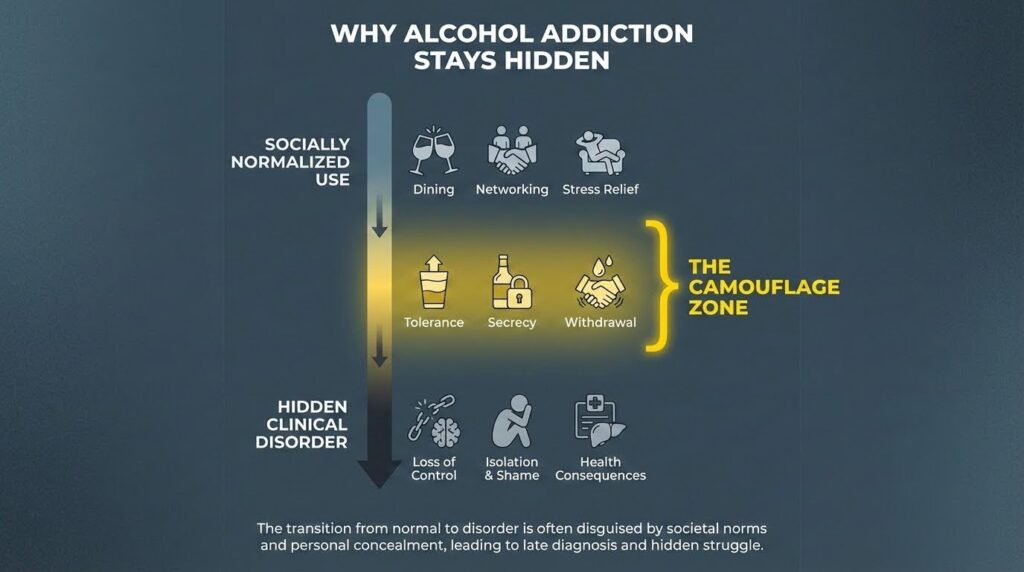
Tolerance rises. The person increasingly relies on the substance to regulate internal states. Routines become more deliberate. Concealment increases. Attempts to cut back may start and fail. External functioning remains largely preserved. This is the classic “high-functioning” zone.
Stage 3: Strain leakage
The cost of maintaining the facade rises. Cracks appear in mood, sleep, relationships, or health. Occupational performance may remain superficially intact, but more effort is needed. Shame and fear of exposure intensify.
Stage 4: Recognition crisis
The person hits a subjective or objective wall. They may feel unable to control use. Consequences threaten a valued identity: career, relationship, health, or self-respect. Denial becomes harder to sustain.
When Do High-Functioning Addicts Seek Help?
Usually later than would be clinically ideal, and typically not at the first signs. National data from the 2024 NSDUH show that about 80% of people who needed substance use disorder treatment did not receive it.
Among high-functioning individuals, the gap is likely even wider because their external stability further reduces perceived need.
What finally changes the calculation?
Crisis works not because stigma vanishes but because denial becomes unsustainable. A DUI, overdose, job warning, medical emergency, relationship rupture, or simply the dawning realization that functioning now depends on the substance can shift the equation.
At that point, the perceived cost of non-treatment finally exceeds the perceived cost of disclosure.
Five things happen at crisis that did not happen before:
It destroys plausible deniability. It externalizes the problem so others can see consequences. It changes the cost equation so that not treating carries greater immediate loss.
It mobilizes systems like emergency departments, employers, family members, or clinicians. And it legitimizes care so the individual finally feels “sick enough” to deserve help.
Why evidence alone rarely persuades before a crisis?
Objective evidence of risk often loses to identity-preserving interpretation. A crisis is harder to narrate away. It disrupts the person’s explanatory framework.
Treatment delay among high-functioning individuals is not best understood as a failure to process facts. It is better understood as a failure of facts to overcome protected identity until disruption becomes undeniable.
Why Does Alcohol Present a Special Camouflage Problem?
A large portion of the workplace literature focuses on harmful alcohol use, and for good reason. Alcohol is legal, socially embedded, often professionally normalized, and difficult to distinguish from accepted social use.
Heavy drinking may be interpreted as ordinary networking or stress release. Alcohol problems can stay hidden longer than some illicit drug use.
Many adults struggle to identify when “social drinking” becomes disorder. Professional settings may reward alcohol-centered bonding. And since many people drink, admitting alcohol addiction feels more contestable than admitting dependence on an illicit substance.
Effective medications for alcohol use disorder exist, including naltrexone and acamprosate. The existence of effective treatment options further supports the conclusion that the main barrier is not therapeutic absence but delayed entry.
The Role of Confidentiality and Trust
Trust is one of the most underappreciated factors in treatment timing. A person with a high-status identity may ask: Who will know? Will this go on my record? Will my employer find out? Will my licensing board be notified? Will I be treated respectfully?
Where confidentiality is uncertain, treatment delay is predictable. People with more to lose are often more confidentiality-sensitive, not less.
Their resources make private coping possible for longer. That means treatment systems must be exceptionally trustworthy to overcome delay.
Even when high-functioning individuals do seek help, they may encounter provider stigma or anticipate it. Research on contingency management found that stigmatizing language appeared in 70% of treatment program transcripts studied.
High-functioning individuals, who are especially sensitive to humiliation and status loss, may be deterred by exactly these treatment climates.
Why This Matters: Crisis is a Systems Outcome, Not a Moral Failure
Crisis-driven treatment entry among high-functioning individuals is not an individual moral failure. It is a predictable systems outcome.
The modern social and workplace environment makes concealment easier than care. Many treatment entry points remain poorly designed for people who are still outwardly functioning.
The most important practical question is not “Has this person fallen apart yet?” It is “How much of their ability to cope, sleep, perform, or feel normal now depends on substance use?” When that dependence begins to substitute for natural self-regulation, help is already warranted.
What would change the pattern?
Moving addiction care into ordinary medical settings would help. Making confidentiality visible and credible would help. Redesigning workplace intervention around trust rather than surveillance would help.
Reducing treatment friction through telehealth, digital tools, and flexible scheduling would help. Actively addressing provider stigma would help. And normalizing non-crisis treatment entry through public messaging would help.
Until systems make early care more confidential, integrated, nonjudgmental, and easy to reach, crisis will continue to function as the main gateway to treatment for people who are still able to look successful while suffering.
You Do Not Have to Wait for a Crisis!
If anything in this article felt familiar, that recognition matters more than you might think. You do not need to hit rock bottom to deserve support. You do not need to lose your job, your family, or your health before reaching out.
If substances have quietly become the thing holding your daily life together, that is reason enough to talk to someone who understands. Take the first step and explore Mosaic’s treatment options that meet you where you are.