

Xanax on an Empty Stomach: Should You Take It With Food?
If you wonder whether you can take Xanax on an empty stomach, the short answer is yes.
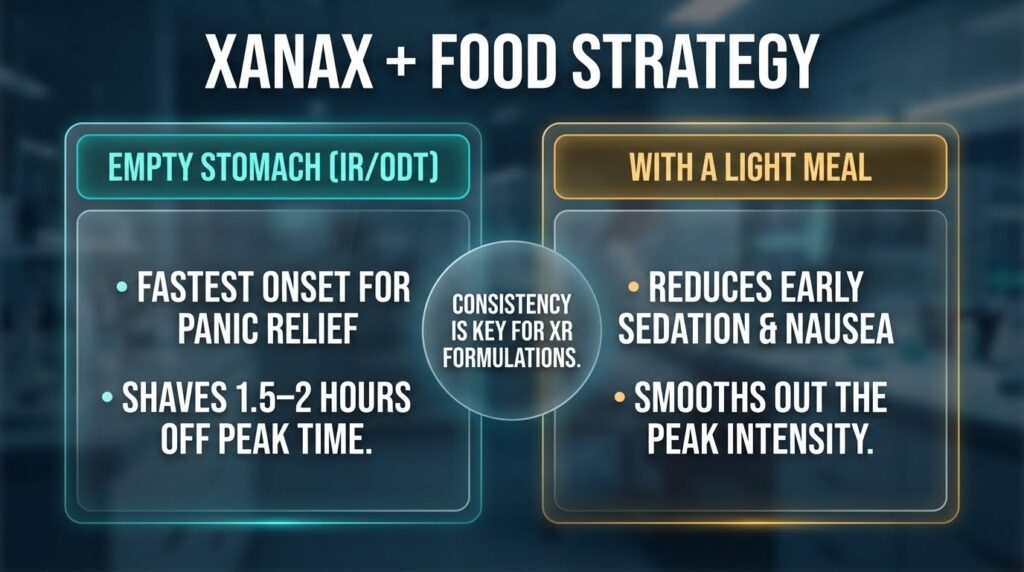
Taking immediate-release alprazolam while fasting produces a peak blood level about 25% higher and reaches that peak roughly 1.5 to 2 hours sooner than taking it after a high-fat meal, according to FDA-reviewed labeling.
Below, you will find a clear breakdown of how food affects each Xanax formulation, when eating first makes sense, and how to keep your dosing safe.
Xanax on an Empty Stomach: What the Data Show?
The question of whether you should take Xanax with food or without food depends largely on which version you use.
Alprazolam comes in three forms: immediate-release (IR) tablets, orally disintegrating tablets (ODT), and extended-release (XR) tablets. Each one responds to food differently.
Immediate-Release and ODT
A randomized crossover study of 16 volunteers taking 1 mg ODT found that eating a standardized high-fat breakfast cut peak concentration (Cmax) by about 25% and pushed the time to peak (Tmax) from roughly 2.2 hours to about 4.4 hours.
Total absorption, measured by AUC, stayed the same. The crossover study authors concluded that food slows the rate of absorption but does not change how much drug your body takes in overall.
What does that mean in plain terms? Taking IR or ODT Xanax on an empty stomach lets the drug reach your bloodstream faster and hit a modestly higher early peak. You do not absorb more of the drug. You just absorb it sooner.
Extended-Release
XR alprazolam behaves in the opposite direction. A high-fat meal eaten up to two hours before dosing raises Cmax by about 25%, and the timing of that meal shifts when the peak arrives. Eating right before the dose shortens Tmax by roughly one-third.
Eating an hour or more before the dose lengthens Tmax by about one-third. Again, total exposure does not change. The XR prescribing information stresses that consistency matters more than any single meal choice.
How Food Changes the Way Xanax Feels?
A faster rise in blood levels does not just show up on a lab chart. It can change how you experience the medication.
A 2023 physiologically based modeling study linked unbound brain concentrations of alprazolam with real outcomes like EEG changes, saccade velocity, mood shifts, and cognitive speed. For a single 1 mg IR dose, the 10 to 90% rise time in the brain was about 22.8 minutes.
For a 3 mg XR dose, that same rise took roughly 3.8 hours. The PK/PD modeling analysis showed that faster rises translate to earlier and sometimes more intense sedation, psychomotor slowing, and mood effects.
So when people say Xanax “hits harder” on an empty stomach, there is a pharmacological basis for that feeling.
The peak is higher and arrives sooner. But the total amount of drug in your system over the full dosing window stays the same. The difference is about timing and intensity, not total effect.
Should You Take Xanax With Food?
Whether you should take Xanax with food comes down to what you are trying to achieve and how your body responds.
When an Empty Stomach Makes Sense
If you need fast relief from a panic attack, taking IR or ODT alprazolam on an empty stomach can shave meaningful time off the onset.
For ODT specifically, a small sip of water advances Tmax by about 15 minutes without changing exposure, according to the Niravam ODT label. That is a minor but useful tweak in an urgent moment.
When Eating First Makes Sense
If you are sensitive to early sedation, dizziness, or stomach upset, eating a light meal before your dose can smooth out the experience. National patient guidance from NAMI confirms that alprazolam may be taken with or without food, and recommends eating if nausea occurs.
For XR users, avoiding a high-fat meal right before dosing helps keep the peak from climbing an extra 25%.
When Consistency Matters Most
For anyone on XR alprazolam, the single most useful habit is taking your dose the same way each day relative to meals and time of day.
Night dosing of XR raises Cmax by about 30% and shortens Tmax by roughly one hour compared to morning dosing. Switching between fasted and fed states from day to day creates unpredictable swings in peak levels.
Xanax With or Without Food: Quick Comparison
| Factor | IR / ODT (Fasted vs Fed) | XR (Fasted vs High-Fat Meal) |
|---|---|---|
| Peak concentration (Cmax) | About 25% higher when fasted | About 25% lower when fasted |
| Time to peak (Tmax) | About 1.5 to 2 hours earlier when fasted | Depends on meal timing |
| Total absorption (AUC) | No change | No change |
| Best strategy for fast relief | Take on empty stomach | Not designed for rapid onset |
| Best strategy for fewer side effects | Take with a light meal | Avoid high-fat meals before dosing; dose in the morning |
Who Should Be Extra Careful?
Not everyone responds to these peak differences the same way. Several groups face higher stakes when Cmax shifts even modestly.
Older adults clear alprazolam more slowly, with half-lives stretching beyond 21 hours. Multiple-dose studies in elderly volunteers showed dose-related sedation and psychomotor impairment that did not fully resolve even after tolerance began to develop. A 25% bump in early peak from fasting can be more clinically meaningful in this group.
People with alcoholic liver disease absorb alprazolam more slowly (Tmax around 3.3 hours versus 1.5 hours in healthy adults) and clear it at roughly half the normal rate.
Research on hepatic impairment found half-lives near 20 hours. For these patients, accumulation and sedation risks outweigh any benefit from chasing a faster onset.
Obese individuals show a mean half-life of about 22 hours, meaning the drug lingers longer and next-day effects become a real concern.
Smokers may have up to 50% lower concentrations than nonsmokers because of enzyme induction, which can blunt the perceived effect regardless of meal timing. The FDA tablets label notes these population differences alongside racial variations in metabolism.
Safety Comes First
Faster onset sounds appealing when anxiety spikes. But a quicker, higher peak also means a faster rise in sedation, cognitive slowing, and psychomotor impairment. That matters behind the wheel, at work, or any time you need to stay alert.
A few non-negotiable safety points apply no matter how you take your dose:
- Never combine Xanax with alcohol or opioids. Boxed warnings on both IR and XR labels highlight the risk of fatal respiratory depression.
- Avoid strong CYP3A4 inhibitors like ketoconazole and itraconazole, which can raise alprazolam exposure by nearly fourfold. No meal strategy can offset that kind of increase.
- Do not crush, chew, or split XR tablets. Breaking the controlled-release matrix can dump the full dose at once.
- Start low in older adults and anyone with liver problems. The recommended starting dose is 0.25 mg two to three times daily with slow increases.
- Do not drive or operate heavy equipment until you know how the medication affects you, especially if you are taking it on an empty stomach for the first time.
Practical Tips for Taking Xanax
If you take IR or ODT and want faster relief, skip the heavy meal. A glass of water with your ODT can shave about 15 minutes off the wait.
If nausea is a problem, a few crackers or a piece of toast before dosing is enough to settle your stomach without meaningfully slowing absorption.
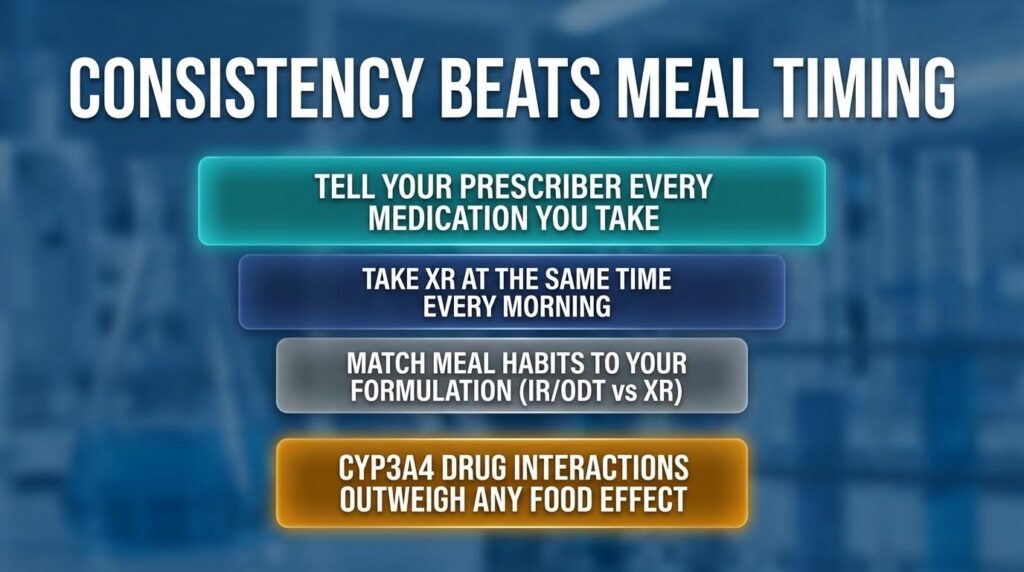
If you take XR, pick a consistent time each morning and stick with it. Eat your normal breakfast, but try to keep it moderate in fat content.
Avoid swinging between fasting one day and eating a large, greasy meal the next. That kind of inconsistency creates the exact peak variability that leads to unpredictable side effects.
For anyone on alprazolam, keep your prescriber informed about every other medication you take. Drug interactions with CYP3A4 inhibitors dwarf any effect that food has on blood levels.
A conversation about your full medication list is worth more than any meal-timing trick.
Why This Matters for Your Daily Routine?
Can you take Xanax on an empty stomach? Yes. Should you? That depends on your goals, your formulation, and your personal risk factors. The roughly 25% difference in early peak concentration is real but moderate.
It can mean the difference between relief arriving in one hour versus three during a panic attack. It can also mean the difference between manageable drowsiness and impairment that puts you at risk.
The best approach is simple: match your dosing habits to your needs, keep those habits consistent, and talk to your prescriber about any changes.
If you are dealing with anxiety or substance use concerns and want professional guidance, reaching out for support is a strong first step. Consider connecting with the team at Mosaic Behavioral Health Center to explore your options.