
DBT vs. CBT: How Each Therapy Supports Emotional Regulation

If your emotions feel bigger than your coping skills, choosing between DBT and CBT can feel confusing. DBT vs. CBT is best understood by matching the therapy to the pattern: CBT often targets thoughts, avoidance, and behavior, while DBT adds skills for crisis urges, fast emotional spikes, and relationship stress. This guide will help you compare both options in plain language.
DBT vs. CBT: The Core Difference
DBT and CBT overlap more than many people think. Both look at thoughts, feelings, actions, and patterns that keep distress going. Both can include homework, practice between sessions, and skills that help you respond differently when anxiety or depression shows up.
The difference is often the starting point.
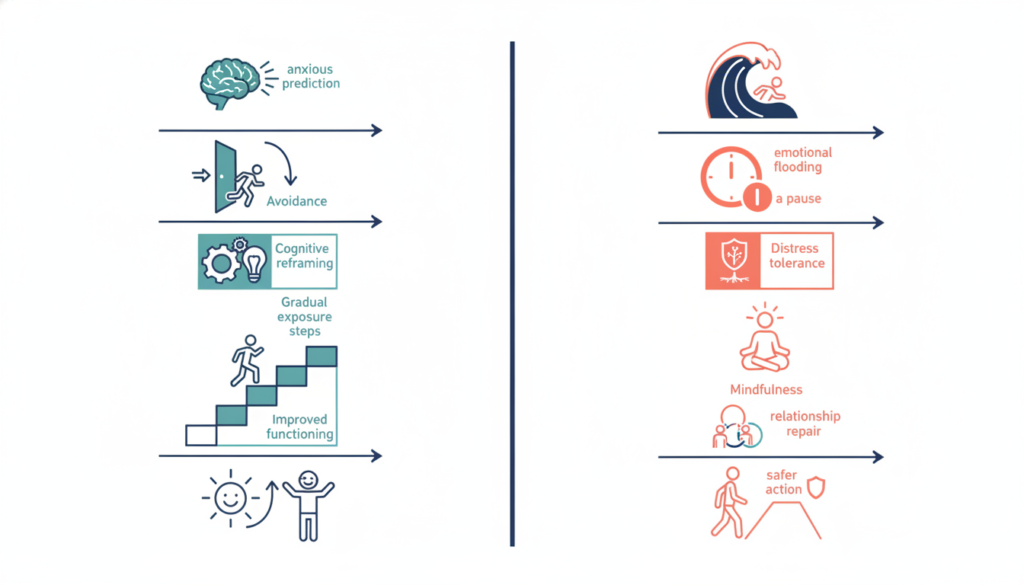
CBT, or cognitive behavioral therapy, usually focuses on how thoughts and behaviors keep anxiety, depression, and avoidance going. If you keep predicting that something terrible will happen, avoid the situation, and never get a chance to test the fear, CBT may fit well.
DBT, or dialectical behavior therapy, was built for people whose emotions rise fast and become hard to manage in real time. DBT still uses behavioral and cognitive ideas, but it adds a strong focus on mindfulness, distress tolerance, emotion regulation, and interpersonal effectiveness. A therapy overview from Psychiatry Advisor describes DBT as combining acceptance and change strategies while teaching skills for emotional and relational stress.
A simple way to think about dialectical behavior therapy vs cognitive behavioral therapy is this: CBT often asks, “What belief or avoidance pattern is keeping this problem alive?” DBT often asks, “What happens when emotion gets so intense that skills, judgment, or safety break down?”
That difference matters because emotional regulation is not only about insight. Many people know, in a calm moment, that a fear may be exaggerated. The problem is that during panic, shame, anger, rejection, or self harm urges, that insight can vanish.
How CBT Supports Emotional Regulation
CBT helps emotional regulation by changing the cycles that feed distress. The goal is not to talk yourself out of every feeling. It is to notice patterns, test predictions, and build behavior that gives your brain new evidence.
For example, someone with social anxiety may think, “If I pause during a meeting, everyone will think I am incompetent.” That thought leads to avoidance, over rehearsing, or staying silent. The short term relief feels helpful, but the fear stays strong because the person never learns what would happen if they spoke up.
CBT would likely help that person identify the fear, look at the evidence, and try small behavioral experiments. Over time, the person may learn that a pause is not a disaster, that others are less focused on them than expected, and that anxiety can rise and fall without needing escape.
CBT can also help depression when withdrawal and hopeless thoughts feed each other. A person may think, “Nothing will help,” then stay in bed, miss contact with others, and feel even worse. Behavioral activation, a CBT tool, can help the person plan small actions that rebuild structure, pleasure, and a sense of ability.
CBT tends to fit best when thoughts are clear enough to examine and the person can practice between sessions without repeated crisis behavior. That does not mean the feelings are mild. It means the person can usually pause, reflect, and try a new response before risk takes over.
How DBT Supports Emotional Regulation
DBT for emotional regulation is especially useful when feelings rise quickly and lead to actions the person later regrets. These actions may include self harm, suicidal communication, impulsive texting, substance use, aggression, withdrawal, or urgent reassurance seeking.
DBT focuses on the gap between knowing and doing. You might know that a delayed text does not always mean rejection, but still feel panic, rage, or shame within minutes. You might understand a coping skill in therapy, then forget it completely when your body feels flooded.
DBT teaches skills for those exact moments.
Mindfulness helps you notice what is happening without instantly becoming the feeling. Distress tolerance helps you survive a crisis without making it worse. Emotion regulation helps you lower vulnerability over time by understanding triggers, body cues, sleep, stress, and habits. Interpersonal effectiveness helps you ask for what you need, set limits, and handle conflict without blowing up or shutting down.
DBT often uses a chain analysis. That means you and your therapist look at the full sequence of an episode. What happened before the spike? What made you more vulnerable that day? What did you think, feel in your body, want to do, and actually do? What gave short term relief? What made life harder later?
This is not about blame. It is about finding the exact points where a skill, boundary, safety step, or different behavior could change the outcome.
Research supports DBT for some high risk patterns. In a randomized trial of 173 adolescents, DBT reduced repeat suicide attempts, nonsuicidal self injury, and total self harm more than supportive therapy right after treatment. That does not prove DBT is better than every form of CBT. It does show why DBT is often considered when self harm and fast emotional escalation are central concerns.
DBT vs. CBT for Anxiety
CBT vs DBT for anxiety depends on what keeps the anxiety going.
If anxiety is mainly driven by fear predictions and avoidance, CBT is often a direct fit. Panic, social anxiety, worry, and avoidance can respond well when a person learns to test feared outcomes and reduce safety behaviors.
If anxiety turns into fast emotional flooding, relationship crisis, self harm urges, or impulsive behavior, DBT may need to come first. In that case, the main problem is not only the fear thought. The bigger concern is what happens when the nervous system goes into emergency mode.
Here is a simple comparison.
| Pattern You Notice | CBT May Fit Best When | DBT May Fit Best When |
|---|---|---|
| Anxious thoughts | You can name and test the thought | The thought quickly turns into crisis urges |
| Avoidance | You avoid feared places, people, tasks, or sensations | Avoidance happens with panic, shutdown, or crisis-level risk |
| Depression | Withdrawal and hopeless thoughts are the main cycle | Depression comes with repeated emotional crises |
| Relationships | You fear judgment but can pause and reflect | Conflict triggers panic, rage, threats, or frantic contact |
| Skill use | You can practice tools between sessions | You need help using skills during real life spikes |
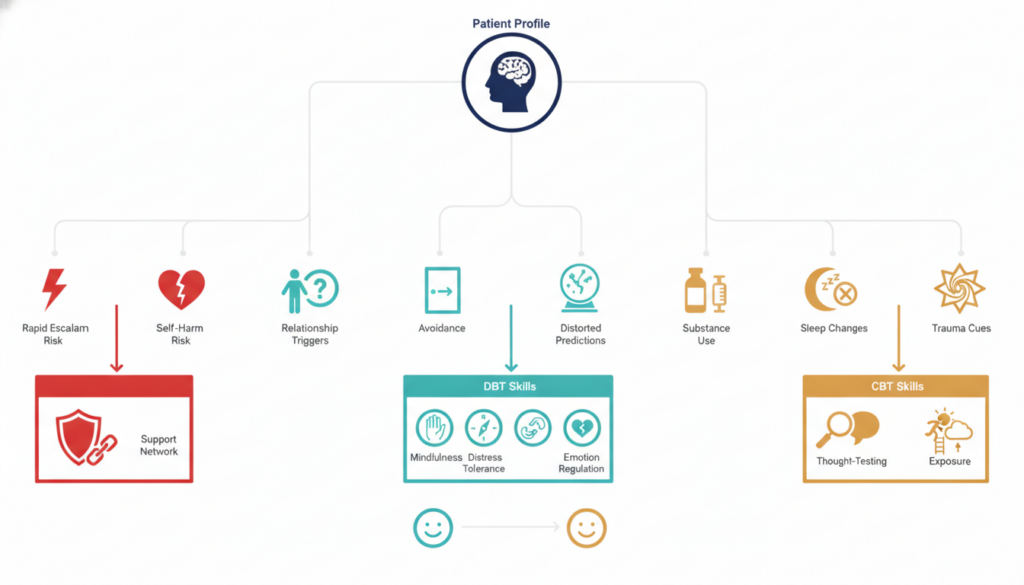
Many people need both. A person may start with DBT to reduce crisis behavior, then use CBT later for social anxiety, trauma related beliefs, or depressive avoidance. Another person may begin with CBT and add DBT skills if emotional spikes keep getting in the way.
The best choice is not based on a label. It is based on the pattern.
When DBT May Be the Better Starting Point
DBT may be the stronger first step when emotions become unsafe, fast, or hard to control.
This can look like feeling fine in the morning, getting one upsetting message, and within an hour feeling desperate, ashamed, angry, or numb. It can look like knowing you should not send twenty texts, hurt yourself, quit your job, or end a relationship in the moment, yet feeling unable to stop.
DBT is also often considered when self harm or suicidal thoughts are part of the pattern. A follow up analysis of adolescent DBT found that emotion regulation improved more in DBT, and self harm remission during the six to twelve month follow up was 49.3 percent in DBT compared with 29.7 percent in supportive therapy. That finding fits the idea that improving emotion regulation can be tied to lower self harm for some teens.
For adolescents, the evidence is not limited to one study. A review of DBT for adolescents included 21 studies and found small to moderate effects favoring DBT for self harm and suicidal ideation. Those results are meaningful, but they are not magic. The quality of the program, family support, risk level, and fit all matter.
DBT may also fit when relationship stress is the main trigger. Some people do not spiral in every setting. They spiral when they feel abandoned, criticized, ignored, rejected, or misunderstood. DBT does not dismiss those feelings. It helps the person slow the sequence from trigger to action so they can protect both safety and relationships.
When CBT May Be the Better Starting Point
CBT may be the better first choice when the problem is more stable, more specific, and more reachable through thought and behavior change.
This could include a person who avoids driving after panic symptoms, avoids presentations because of fear of embarrassment, stays in bed because depression says nothing will help, or worries for hours because uncertainty feels intolerable.
In these cases, CBT can help by making the pattern visible. The therapist may ask what you predicted, what you did to feel safer, what you avoided, and what happened after. Then you test a new response. You may learn that anxiety is uncomfortable but not dangerous, that embarrassment is survivable, or that small activity can shift mood even when motivation is low.
CBT is not shallow, and it is not just positive thinking. Good CBT can be hard work. Exposure, behavioral activation, and testing beliefs require courage. The difference is that the person usually has enough stability to practice without repeated crisis support.
CBT can also support emotional regulation by reducing the triggers that keep emotions intense. If your panic is fed by fear of body sensations, learning that those sensations are not harmful can reduce the whole emotional wave. If depression is fed by isolation, changing the daily pattern can shift mood over time.
Safety Comes Before Therapy Labels
If suicidal thoughts, self harm, or dangerous urges are present, treatment choice should begin with safety. That means asking direct questions about current thoughts, intent, plans, past attempts, access to lethal means, substance use, and support.
A safety plan is not a sign that someone is “too much.” It is a practical tool. The VA and DoD guideline highlights safety planning and lethal means counseling as parts of suicide risk care. In plain terms, therapy should help reduce access to danger and increase access to support before a crisis peaks.
It is also important to tell the difference between nonsuicidal self injury and suicidal behavior. Both deserve care. Both can signal serious distress. But they may have different functions. Some self injury is used to reduce emotional pain, end numbness, punish the self, or communicate distress. A good therapist will ask what the behavior does in the moment, not assume the answer.
If there is immediate danger, outpatient therapy is not enough by itself. Emergency support, crisis services, or a higher level of care may be needed. DBT and CBT can be part of healing, but they do not replace urgent safety care.
Watch for Bipolar and Trauma Signals
Strong emotions are not always the same as emotion dysregulation. Some patterns need a careful mental health assessment before deciding on DBT, CBT, or both.
Bipolar disorder can be confused with emotional reactivity because both may involve impulsivity, intense mood, and risky choices. The key difference is the time course. Bipolar activation involves a clear shift in mood and energy that lasts across situations. Manic episodes involve at least one week of elevated, expansive, or irritable mood with increased energy, unless hospitalization is needed sooner, while hypomanic episodes last at least four days and show an observable change.
Relationship triggered mood shifts may last minutes, hours, or a few days and settle after repair or reassurance. Bipolar episodes tend to involve changes in sleep, energy, speech, confidence, activity, and judgment that are not limited to one conflict.
Trauma can also shape emotional regulation. A person may react strongly to tone of voice, silence, closeness, conflict, or reminders of past harm. That does not mean they are overreacting. It means the body may be responding to threat cues. Treatment may need grounding, safety, DBT skills, CBT work on beliefs, and later trauma focused care when the person is stable enough.
How a Therapist Chooses the Right Fit
A good therapist does not choose DBT or CBT from a diagnosis alone. They look at what keeps the problem going.
They may ask about recent emotional episodes, how fast feelings rise, what happens in the body, whether thoughts are accessible during distress, what actions follow, and what gives short term relief. They may also ask about sleep, substance use, trauma reminders, relationship patterns, suicidal thoughts, self harm, family history, and past therapy.
Broad symptom tools can help, but they do not replace a real formulation. The American Psychiatric Association offers assessment measures that can guide further questions across areas like depression, anxiety, sleep, anger, and mania. Still, the score is not the treatment plan.
The treatment plan should answer a practical question: what process turns distress into impairment?
If the answer is avoidance and distorted prediction, CBT may be the cleanest start. If the answer is rapid escalation, self harm urges, and relationship crisis, DBT may be the safer and more targeted start. If both are true, a staged plan can make sense.
Why This Choice Matters
The right therapy fit can change the whole experience of care.
If you are sent straight into cognitive work when you cannot think clearly during a crisis, you may feel like therapy is blaming you for not using insight you genuinely cannot access in the moment. If you are placed in full model DBT when your main issue is a specific phobia or social anxiety pattern, you may spend time and energy on a program that is more than you need.
DBT and CBT are both useful. The question is timing, fit, and safety.
DBT can help you build a pause between emotion and action. CBT can help you test the fears and habits that keep anxiety and depression alive. Together, they can support a more flexible life, where feelings still matter but do not have to run every decision.
If you are unsure which approach fits, start with an assessment that looks at your patterns, risk, goals, and support system. If you are ready to talk through your options, Mosaic Wellness & Recovery can help you start with outpatient therapy that matches your needs.