
DBT vs. CBT: Key Differences and Who Each Therapy Helps

Wondering whether DBT vs CBT is the right question to ask before starting therapy? CBT works best when avoidance, negative thinking, or inactivity keep someone stuck, while DBT was built for intense emotions and repeated self harm, and in one trial DBT nearly doubled the self harm remission rate compared with supportive therapy. This guide breaks down what each therapy targets, who tends to benefit most, and when combining them makes sense.
DBT vs. CBT: What Each Therapy Actually Targets
CBT and DBT share a lot of DNA. Both are structured, collaborative, and built around the link between thoughts, feelings, and actions. Where they part ways is in what each one treats as the main problem.
Cognitive behavioral therapy zeroes in on unhelpful appraisals and behavior patterns that keep distress going. Think avoidance, reassurance seeking, compulsions, withdrawal, and rumination. Dialectical behavior therapy grew out of that same tradition but organizes everything around a different core issue: pervasive emotion swings, trouble tolerating distress, impulsive behavior, and repeated self harm or suicidal crises that keep derailing daily life and treatment itself.
In full clinical terms, this is dialectical behavior therapy vs cognitive behavioral therapy, and the real difference comes down to mechanism, not diagnosis. A person can have generalized anxiety disorder and need straightforward CBT. Another person with the exact same diagnosis, but who also self harms after every argument, may need DBT’s structure first. Diagnosis alone will not tell you which path fits.
How CBT Works to Change Thoughts and Actions
CBT treats distress as a two way exchange between thinking, feeling, and behaving. A therapist helps you spot automatic thoughts, weigh them against real evidence, and build behavior that supports a steadier view. For depression, that often means behavioral activation, or getting back into activities that used to matter even before motivation shows up on its own.
The evidence here is large. A large trial review covering more than 52,000 patients across 409 trials found moderate to large effects for CBT in depression, across age groups and treatment settings. That review also noted the newer studies tend to use active comparisons rather than simple waiting lists, which makes the findings more trustworthy.
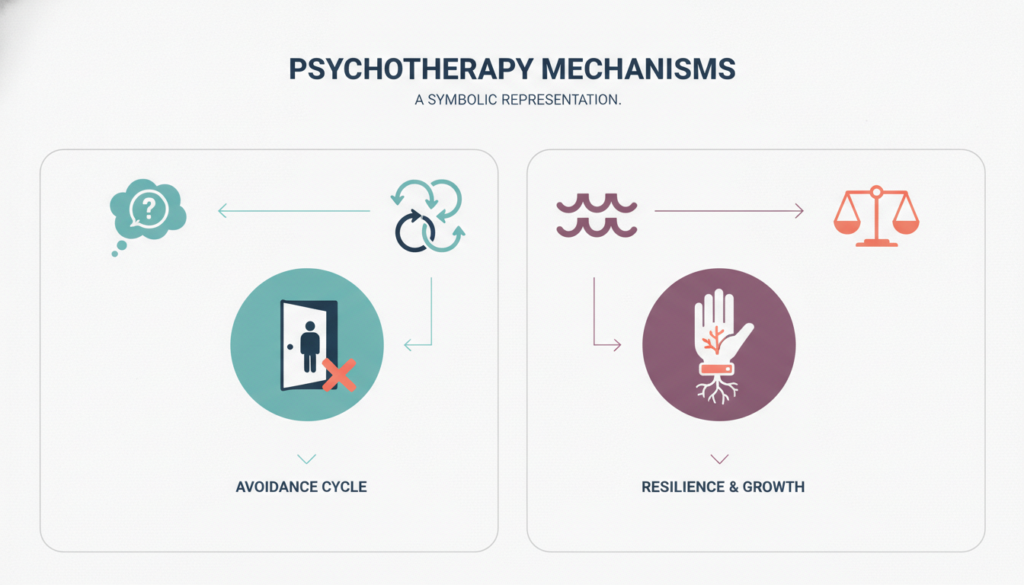
CBT is not just cognitive work either. Exposure, problem solving, and reducing safety behaviors matter just as much as challenging a thought. For someone whose anxiety is maintained by avoidance, no amount of relabeling a thought will help if they never test the feared situation.
DBT vs. CBT for Anxiety and OCD
Anxiety disorders are often described as CBT’s home turf, and for good reason. Exposure, cognitive work, and cutting back on safety behaviors give people a way to test feared predictions instead of avoiding life around them. That said, the picture is not one directional.
A 2022 review of placebo controlled trials found a smaller pooled effect on anxiety symptoms than popular claims suggest, and most of the studies in that pool were about PTSD rather than social anxiety, panic, or generalized anxiety. So when weighing CBT vs DBT for anxiety, the honest answer is that CBT should usually come first when avoidance and safety behaviors are running the show. DBT skills can still help, mainly as support for staying in an exposure exercise long enough to learn something new, especially for someone prone to big emotional swings.
OCD deserves its own note. Exposure and response prevention, not generic CBT or DBT, remains the treatment of choice for compulsions and rituals. The OCD treatment guide from the International OCD Foundation is direct about this: DBT can help someone tolerate distress and resist an urge, but it is meant to support exposure work, not replace it. Skipping response prevention in favor of pure distress tolerance tends to leave the compulsion cycle fully intact.
DBT for Emotional Regulation and Crisis Moments
DBT for emotional regulation was the whole point of the model from day one. It was built for people whose feelings escalate fast, stay high, and sometimes lead to self harm or suicidal crises that make regular outpatient therapy hard to sustain. Full DBT programs teach four skill sets:
- Mindfulness, or noticing the moment without judging it
- Distress tolerance, or getting through a crisis without making it worse
- Emotion regulation, or understanding and shifting intense feelings
- Interpersonal effectiveness, or asking for what you need and setting limits
Beyond the skills, DBT follows a target hierarchy. Life threatening behavior comes first, then behavior that disrupts therapy itself, then quality of life problems, then general skill building. That order matters for anyone with a self harm history because it keeps sessions from drifting away from the riskiest issue in the room.
In a randomized trial of 173 suicidal and self harming teens, six months of DBT reduced self harm more than supportive therapy during active treatment. A later look at that same trial found teens with higher baseline emotional swings tended to gain the most from DBT specifically, which is a decent clue about who fits this model best.
The strength of DBT for this population also has guideline backing. The 2024 APA guideline for borderline personality disorder names structured psychotherapy, DBT included, as the main treatment, with medication playing only a supporting role.
DBT vs. CBT for Depression and Self Harm
Depression on its own is usually CBT territory. When low mood is driven by withdrawal, inactivity, and rumination, behavioral activation and cognitive work are a direct match. Depression that keeps circling back with repeated self harm or suicidal crises is a different story, and it changes which therapy should organize the plan.
A component trial of 99 women with severe suicidal behavior and borderline personality disorder compared full DBT, skills training paired with case management, and individual DBT without skills. All three groups improved on suicide attempts and thoughts of suicide. But the two groups that included skills training showed bigger drops in nonsuicidal self injury, depression, and anxiety than individual therapy alone. Full DBT also kept people in care better, with about 24 percent dropout compared with roughly 48 percent in the group missing skills training.
Timing matters for depression too. A 2024 review of 19 trials found that psychotherapy, whether alone or paired with medication, cut relapse and rehospitalization well below medication alone during the year after treatment stopped. That is a solid reason to think about relapse prevention as part of the plan, not an afterthought once symptoms settle.
Can CBT and DBT Work Together
These two approaches are not rivals fighting over the same patient. A person with contamination based OCD who also self harms after conflict might use DBT informed distress tolerance to sit with an urge, while still doing full exposure and response prevention for the actual compulsions. Neither piece has to wait for the other to finish.
A GAD trial that compared individual DBT sessions with CBT for generalized anxiety disorder found DBT skills training helpful for that group. It did not test people with suicidal behavior, though, so it does not prove DBT should replace CBT for routine anxiety. The realistic move for someone with both problems is usually staged: stabilize safety first, build emotion regulation skills next, then bring in or keep going with the exposure work that treats the anxiety or OCD directly.
Why It Matters: Matching Treatment to the Problem
Getting this choice right changes outcomes. Suicide focused CBT has its own solid track record. In one trial cited by suicide prevention research, brief CBT cut repeat suicide attempts to about 24 percent over eighteen months, compared with about 42 percent for usual care. That is a good reminder that DBT is not the only therapy relevant to suicidal behavior, and CBT is not only for mild anxiety and mild depression.
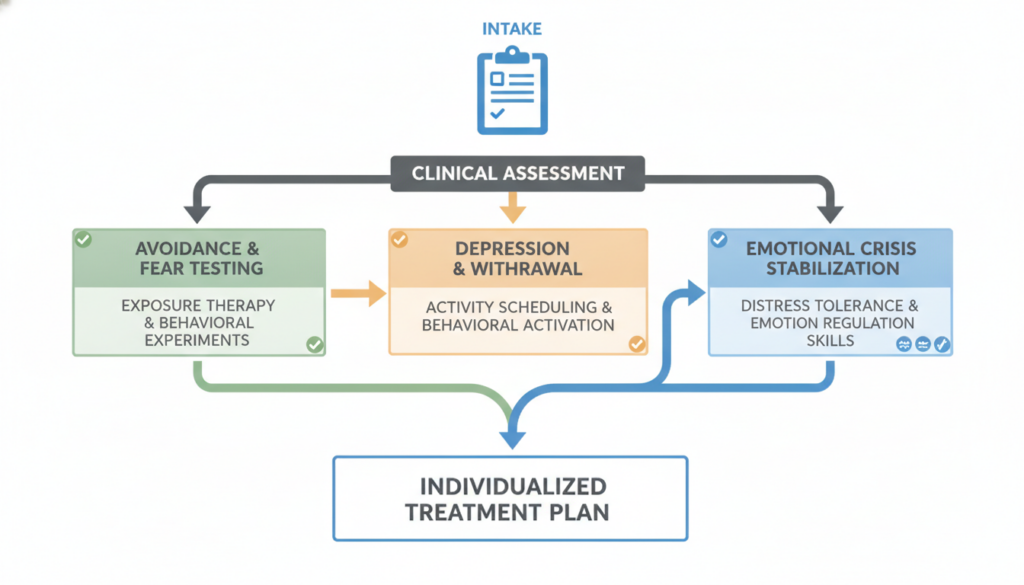
If you start therapy and do not see progress after a fair trial, treat that as a signal to check the fit, not proof the whole approach failed. Ask whether sessions actually targeted the behavior keeping you stuck, whether skills practice or homework happened between sessions, and whether the original diagnosis still matches what you are living with now. Sometimes the answer is more of the same treatment, delivered with more consistency. Sometimes it is adding the other model. Either way, the goal stays the same: match the treatment to the mechanism, not to a label.
If you are trying to work out which approach fits your situation, talking it through with a clinician who knows both models can save you months of guessing. Reach out today to learn more about our outpatient therapy program and find the right next step for you.