
Early Signs of Bipolar Disorder in Adults: What to Know

Bipolar disorder can be hard to spot in adults because early signs of bipolar disorder often look like stress or finally feeling better after depression, not a condition needing treatment. The clearest clue is a change lasting four or more days straight, like sleeping three hours without feeling tired or spending money out of character. This guide covers the signs of bipolar disorder and hypomania signs adults miss, plus how it gets diagnosed.
Early Signs of Bipolar Disorder in Adults
Bipolar disorder rarely shows up as one dramatic moment. It tends to show up as a pattern, a stretch of days where someone’s mood, energy, and behavior shift together in a way that lasts and that other people notice. Bipolar disorders involve mood episode patterns that affect energy, activity, and daily functioning, usually lasting days to weeks, with calmer stretches in between.
Three details matter most when you are trying to tell an early sign from an ordinary mood swing. They are duration, whether other people can actually see the change, and whether the behavior is truly out of character for that person. Clinical guidance calls for a shift lasting at least four consecutive days, present most of the day, nearly every day, along with a real, visible change in how the person functions.
That means a rough Tuesday, a great week at work, or one late night out is not, on its own, an early sign of bipolar disorder. What counts is a sustained pattern that others can point to and describe plainly as unlike the person they know.
Why It Is Easy to Miss
The tricky part is that early signs of bipolar can feel good while they are happening. A person might feel unusually confident, sharp, and social. They may credit a new job, better sleep habits, or simply turning a corner after a hard season. Because the experience feels positive, people rarely bring it up in a doctor’s appointment the way they would bring up sadness or fatigue.
This is part of why bipolar disorder often gets missed for years, or gets treated only as depression, since most people seek help while they are down rather than while they are up.
Hypomania Signs That Are Easy to Miss
Hypomania signs often get mistaken for simply having a good week. The person seems more confident, more talkative, more driven than usual. Family members may even feel relieved, especially after watching someone struggle through depression. Hypomania is generally described as an elevated or irritable mood paired with more energy than usual, and it is less severe than full mania.
Here is where it gets confusing. Hypomania can look a lot like recovery. A person who was sleeping twelve hours a day during depression may start sleeping seven or eight hours and seem like their old self again. That is probably just relief, not hypomania. Real hypomania signs go further than a return to normal. Watch for a combination of:
- Needing only three or four hours of sleep and not feeling tired the next day
- Talking noticeably faster or louder, or being hard to interrupt
- Starting several big projects at once without finishing any of them
- Spending money in a way that is out of character, like sudden large purchases
- Feeling unusually confident, even to the point of taking risks that seem unwise
- Becoming irritable or easily angered rather than simply happy or upbeat
A diagnosis of bipolar II disorder specifically requires at least one hypomanic episode along with at least one major depressive episode, and no history of full mania. Because hypomania can feel productive and pleasant in the moment, many people never report it as a symptom at all.
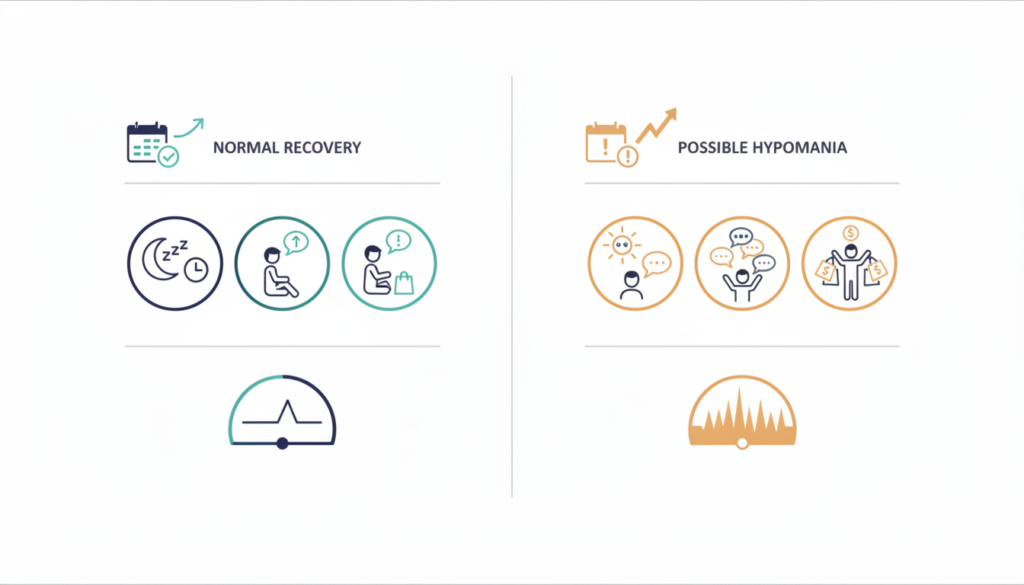
How Hypomania Differs From Feeling Better
The comparison that matters is not “depressed self versus current self.” It is “usual healthy self versus current self.” A person recovering from depression who returns to their normal sleep, normal work pace, and normal social life is likely just getting better. A person who blows past their own normal baseline, sleeping far less than usual while feeling wired instead of tired, taking on far more than they normally would, and behaving in ways that surprise the people who know them best, may be showing something else entirely.
More Signs of Bipolar Disorder to Watch For
Beyond sleep and energy, several other signs of bipolar disorder tend to show up together during an episode rather than on their own. Clinical protocols list an associated symptoms list that includes inflated self esteem, racing thoughts, distractibility, and excessive involvement in activities that carry a real risk of painful consequences, things like impulsive spending, risky driving, or sudden choices that are unlike the person’s usual behavior.
Mood does not have to look happy or excited to count. Some episodes show up mostly as irritability, impatience, or a short fuse rather than joy. When mood is only irritable, more accompanying symptoms are generally needed before it counts as an episode, since irritability alone shows up in plenty of other conditions too, including anxiety, ADHD, and plain exhaustion.
Why Family and Partners Notice First
This is exactly why the people closest to someone often catch on before the person does. Someone experiencing hypomania may describe themselves as finally productive, while a partner sees someone who has barely slept in days, is making decisions that do not add up, and gets defensive the moment anyone raises a concern. Clinical guidance points to collateral information from family and partners as often decisive, since people with bipolar spectrum conditions may not recognize their own hypomania as a problem in the moment.
If you are the one watching from the outside, specific, dated observations are far more useful than a general sense that something feels off. Noting how many hours someone actually slept, what they said, what they spent, and how many days the pattern lasted gives a clinician something concrete to work with rather than a vague impression.
How Is Bipolar Disorder Diagnosed
So how is bipolar disorder diagnosed? Mostly through a careful history of mood over time, not a single visit or an online quiz. There is no blood test or brain scan that confirms bipolar disorder on its own.
A thorough evaluation, in line with clinical practice guidelines used across mental health care, reconstructs a person’s whole mood history. That means past depressive episodes, past periods of unusual energy or activity, how long each one lasted, how the person functioned in the calmer stretches between them, family history, substance use, and any medical conditions that might explain the pattern instead.
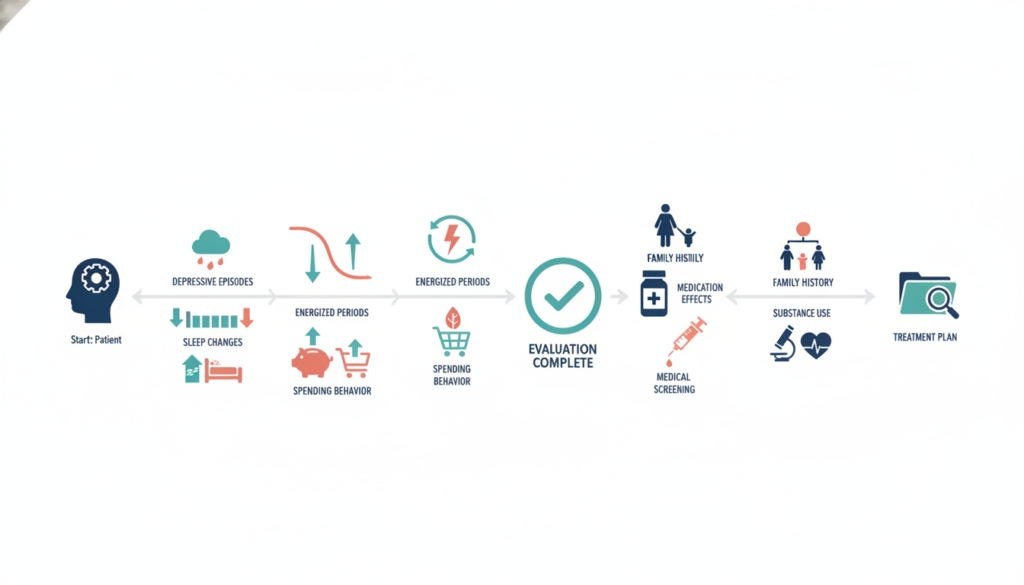
What a Full Evaluation Looks At
Guidelines developed with input from mood disorder specialists stress that this kind of mood history building matters because people often seek care while depressed and may not recognize a past hypomanic stretch as anything other than a good patch. That is one reason clinicians ask about sleep, spending, relationships, and work performance across a person’s whole adult life, not just the last few weeks.
A clinician will typically ask about:
Onset and length of past mood episodes, how those episodes affected work and relationships, whether family members have a history of bipolar disorder, and whether symptoms line up with a new medication, a substance, or a medical condition rather than a standalone mood disorder.
Why One Symptom Is Not Enough
Screening questionnaires can flag a concern worth raising with a professional, but they cannot diagnose bipolar disorder on their own, since irritability, poor sleep, and impulsivity show up in plenty of other conditions too. A full workup usually also checks for thyroid problems, substance use, and medication side effects before settling on a bipolar diagnosis.
Getting the diagnosis right matters because the treatment path differs quite a bit. Antidepressants alone, without a mood stabilizing plan, are usually not the right long term approach once hypomania or mania has been part of someone’s history.
Why Getting Help Early Matters
Catching the signs of bipolar disorder early changes what happens next. Left unaddressed, an activated period can escalate into something more severe, or feed a harder depressive crash later on. Treating it as plain depression alone can also lead to a treatment plan that does not fit the real pattern.
The good news is that a clear pattern, once named accurately, responds well to care. Mood stabilizing treatment, therapy, steady sleep, and ongoing monitoring can reduce how often episodes happen and how much damage they cause to work, relationships, and finances over time.
If you have noticed several days of reduced sleep without tiredness, racing speech, spending that is out of character, or a mood shift that people close to you say is not like you, that pattern is worth naming out loud to a professional rather than waiting it out on your own.
If this sounds familiar for you or someone you love, reach out to Mosaic Wellness & Recovery and ask about our outpatient mental health program to get a clear, professional look at what is going on.