
How EMDR Therapy Helps the Brain Process Trauma and PTSD

If a memory from years ago still makes your heart race like it just happened, you are not imagining it, and you are not broken. EMDR therapy works by pairing a brief recall of the distressing memory with guided eye movements or other rhythmic stimulation, and a review of 26 clinical trials found this approach produced a large reduction in PTSD symptoms. This article breaks down what actually happens in a session, why the brain responds the way it does, and what the research says about results.
What Is EMDR Therapy and How Does It Work
EMDR stands for Eye Movement Desensitization and Reprocessing. It is a structured therapy built around the idea that traumatic memories can get stored in a raw, poorly integrated way in the brain. The image, the fear, the body sensations, and the harsh belief about yourself, like “I am not safe,” stay easy to trigger years later.
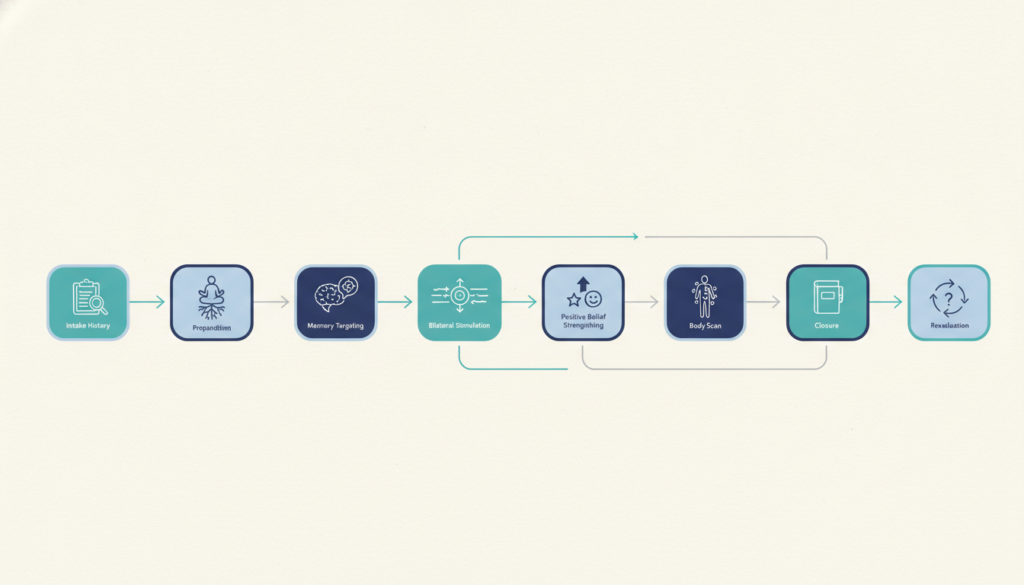
Treatment follows an eight phase protocol that includes history taking, preparation, memory assessment, active reprocessing, and follow up review. It is not just eye tracking. A therapist also builds a plan around a three pronged model: past memories that feed current symptoms, present day triggers, and future situations you want to handle differently.
So what is EMDR therapy meant to change, exactly? Not the fact that something happened. The goal is to lower how much a memory still feels like a current threat, so you can remember it without your body reacting as if it is happening again.
How EMDR Helps the Brain Process Trauma
This is the part people ask about most: how does EMDR work if it just involves watching a finger move back and forth?
The leading explanation involves working memory. Your brain can only hold so much at once. When you recall a distressing memory while also tracking a moving light, tone, or tap, that second task competes for the same mental space. Studies summarized in working memory research found that recalling a disturbing memory while doing a demanding second task reduced how vivid and emotional that memory felt, more than recall alone.
A broader brain mechanism review found similar effects from tasks besides eye movements, including counting, drawing, and shadowing sounds. Faster eye movements, which are harder to track, sometimes produced a bigger drop in emotional intensity than slower ones. That pattern fits the idea that a heavier mental load, not the eye motion itself, is doing much of the work.
None of this means eye movements are pointless. It means the moving light is a tool for creating dual attention, that split focus where part of you is remembering and part of you is here, safe, in the room. That split focus seems to be what lets the brain start filing the memory differently instead of reacting to it as if danger is still active.
The Eight Phases of EMDR for Trauma and PTSD
A full course of EMDR for trauma is not one long session of eye movements. It builds in stages, and skipping ahead tends to backfire.
- History and planning, where the therapist maps your trauma history and current symptoms
- Preparation, where you learn grounding skills and agree on a signal to pause
- Assessment, where you and the therapist pick a specific memory and rate how disturbing it feels
- Desensitization, the active reprocessing phase using bilateral stimulation
- Installation, which strengthens a more accurate belief like “I survived” or “I have choices now”
- Body scan, checking for leftover tension tied to the memory
- Closure, making sure you leave grounded even if the memory is not fully resolved
- Reevaluation, checking in at the start of the next session on how things landed
This phase breakdown guide notes that these phases are not one per appointment. Preparation alone can take several sessions, especially for people with a long trauma history or a tendency to dissociate, and that is not a sign anything is going wrong. It is the part of treatment that makes the harder work safe to do.
Why EMDR Therapy Works for PTSD, According to Research
EMDR is not a fringe technique. It has been studied for decades, and major treatment guidelines now reflect that.
The VA and DoD guideline gives EMDR its strongest recommendation for adult PTSD, placing it alongside Cognitive Processing Therapy and Prolonged Exposure. The ISTSS treatment guideline supports it for adults with clinically significant symptoms even in the first few months after a traumatic event. The APA’s 2025 guideline recommends it too, though with a more cautious wording than the VA and DoD document. That difference comes down to how each group weighs evidence certainty and comparison studies, not a claim that EMDR fails to help.
The federal PTSD research office describes it as one of the most heavily studied trauma treatments available, with dozens of controlled trials behind it. A widely cited analysis of those 26 clinical trials found meaningful drops not only in PTSD symptoms but also in depression, anxiety, and general distress after treatment.
Here is the plain answer if you are wondering whether EMDR for PTSD actually holds up under scrutiny: yes, according to multiple national guideline bodies, though it is one strong option among a few, not the only one that works.
| What research measured | What it found |
|---|---|
| PTSD symptom change | Large reduction across 26 randomized trials |
| Depression symptoms | Meaningful reduction alongside PTSD gains |
| Guideline endorsement | Strong recommendation from VA and DoD; conditional from APA |
| Mechanism | Dual attention tasks reduce memory vividness and emotional charge |
What to Expect Between EMDR Sessions
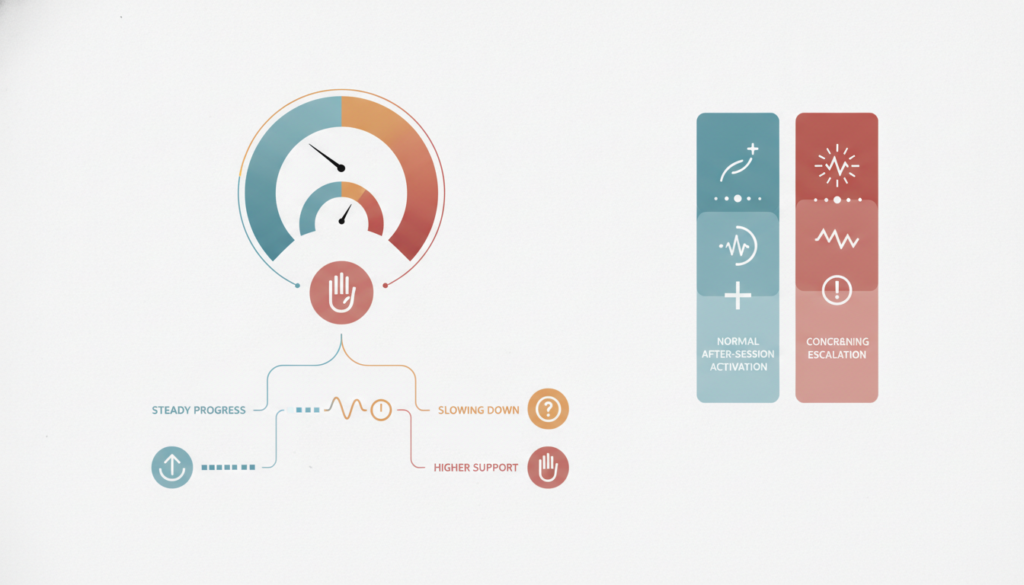
Processing does not always stop when the session ends. Your brain may keep working on the material for a day or two afterward, and that is usually expected rather than alarming.
Common reactions noted in expected side effects research include tiredness, vivid dreams, brief mood shifts, and new memories or associations surfacing on their own. These effects tend to ease within a day or two and usually do not stop you from getting through your normal routine.
What is not expected: symptoms that keep getting worse after each session, an inability to function at work or home, repeated loss of time or memory, or a return of self harm thoughts. If that happens, tell your therapist right away. It usually means the pace needs to slow down, not that EMDR for trauma is the wrong choice altogether.
Finding the Right Support for Trauma Recovery
You do not have to carry this alone, and you do not have to figure out the right pace by yourself either. A trained therapist can help you decide whether EMDR fits your history and walk you through it at a speed your nervous system can actually handle.
If you are ready to talk to someone about trauma or PTSD, reach out to learn more about our mental health programs and take the next step toward feeling steady again at Mosaic Wellness & Recovery.