
Late-Diagnosed Autism in Adult Women and Professionals

If you’re a woman or a working professional who just learned you might be autistic after years of anxiety or depression diagnoses, you’re not alone. In a nationwide study, 54% of women later diagnosed with autism had already been diagnosed with anxiety, depression, or another mental health condition first. This article explains why late diagnosed autism in adults is so common in women and professionals, how masking hides it, and what a good assessment covers.
What Late Diagnosed Autism in Adults Looks Like
Autism is a condition you’re born with, even if nobody notices the signs until you’re 35 and falling apart after a work trip. That gap between when the traits start and when someone finally names them is what people mean by late diagnosed autism in adults.
The numbers back up how common this gap is for women. A nationwide Swedish study followed more than 72,000 people with autism diagnoses and found that 54.2% of females had at least one psychiatric diagnosis before their autism was identified, compared with 40.9% of males. More striking, 28.3% of females had two or more prior diagnoses, versus just 13% of males. Anxiety was the single most common diagnosis that came first for women.
That pattern held even in recent years. Researchers checked people diagnosed between 2010 and 2020 and still found women were diagnosed later and with more prior labels attached, despite growing public awareness of autism in girls. So this isn’t an old problem that fixed itself once clinicians knew better. Something about how autism shows up in women still slips past standard evaluation.
Anxiety often becomes the label of choice because it’s visible and familiar to clinicians. Worry before meetings, avoidance of noisy rooms, and racing thoughts before change all fit neatly into a standard anxiety framework. What often goes unasked is why the worry shows up so predictably around sensory or social complexity rather than around the things anxiety usually targets, like health, money, or safety. That detail tends to point toward autism rather than away from it.
Why Autism in Women Gets Missed for Years
Part of the answer is straightforward. Autism in women often looks different from the presentation that shaped early research and diagnostic checklists, most of which centered boys. Girls and women are more likely to have learned, sometimes painfully, how to blend in.
National health records covering over 338,000 patients diagnosed between 2015 and 2024 show the median diagnosis age for boys dropped to 5, while for girls it stayed around 8. In 2024, one in four newly diagnosed females were identified as adults, compared with about one in eight males.
Where someone gets evaluated matters too. Diagnostic delay research found women were diagnosed only 1.3 years later than men in clinical settings, but 5.8 years later in community samples, and there was no gap at all in standardized research studies. That tells you the delay isn’t really about women presenting differently in some fixed way. It’s about referral paths, clinic habits, and what gets noticed in a short appointment.
How Autism Masking Hides the Struggle
Autism masking, sometimes called camouflaging, means using learned strategies to make autistic traits less visible: rehearsing what to say before a conversation, copying other people’s facial expressions, forcing eye contact, or memorizing social rules instead of picking them up naturally.
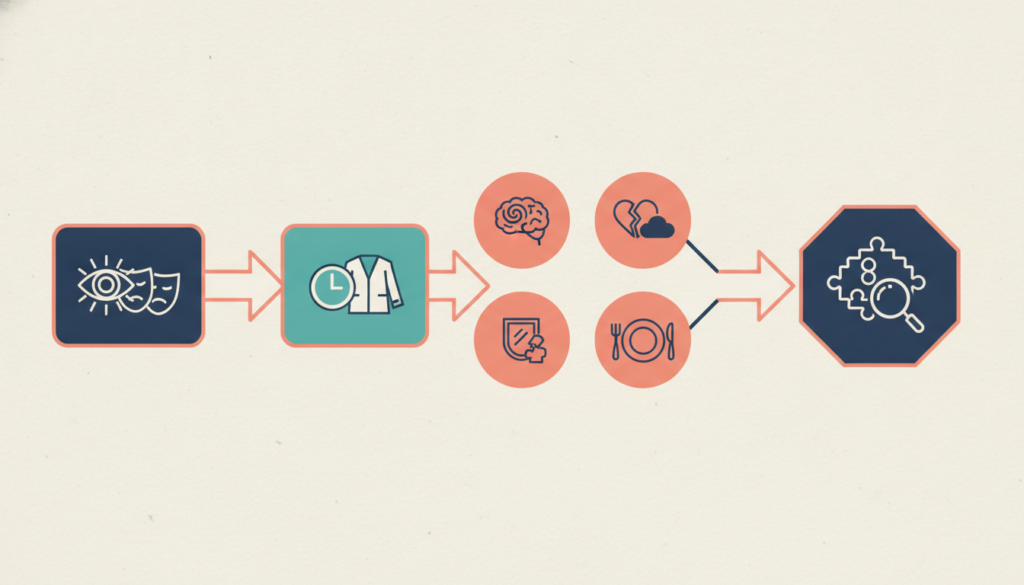
Here’s the problem for diagnosis. A clinician watching someone perform well in a single appointment may reasonably conclude that person doesn’t need much support. What that clinician doesn’t see is the hours of preparation beforehand, the mental script running during the conversation, or the collapse afterward. Masking research notes that camouflaging can genuinely reduce how many autistic traits show up during brief clinical observation, which helps explain why some assessments miss people who mask heavily.
Common signs of masking include:
- Rehearsing conversations or scripting responses in advance
- Copying others’ tone, gestures, or facial expressions on purpose
- Forcing eye contact that feels physically uncomfortable
- Needing hours or days to recover after socializing
- Feeling like you’re performing a role rather than being yourself
- Suppressing repetitive movements or habits in public
None of this proves someone is autistic on its own. But if this list sounds familiar and it’s been true since childhood, it’s worth raising with an evaluator who understands adult presentations, not just childhood ones.
Undiagnosed Autism in Professionals at Work
Undiagnosed autism in professionals often gets mistaken for something else entirely: perfectionism, introversion, or plain old work stress. A lawyer, doctor, teacher, or manager can build an entire career on structure, preparation, and rules, all of which happen to suit an autistic brain quite well, right up until the demands change or multiply.
Picture a marketing director who preps for every client call the night before, studies people’s tone on past emails, and needs an entire evening of quiet after back to back meetings. On paper, she’s high performing. Underneath, she may be running an exhausting, mostly invisible operation just to keep her job looking effortless.
Competence at work doesn’t rule out autism, and it often hides it. Someone can run a meeting flawlessly and then need total silence for the rest of the evening to recover. Promotions can make things worse rather than better, since more unstructured social demand, more small talk, and more office politics tends to come with seniority.
This is also where the anxiety and depression diagnoses tend to start. A professional woman under constant sensory and social strain at work may genuinely meet criteria for generalized anxiety. That diagnosis can be accurate and still miss half the picture, because standard anxiety treatment rarely asks whether the environment itself, not just the person’s thinking, is the source of the overload.
When It Looks Like Anxiety, Depression, or BPD
Anxiety is the diagnosis most strongly linked to later autism identification in women, but it’s far from the only one. Borderline personality disorder deserves particular attention because of how often it gets questioned after an autism diagnosis arrives.
An adult misdiagnosis study of over 1,200 mostly late diagnosed autistic adults found that about a third of women, compared with roughly one in six men, reported at least one earlier diagnosis they came to see as incorrect. Personality, mood, and anxiety diagnoses were named most often. That’s a meaningful signal, but it’s worth being careful with, since it measures what people believed in hindsight, not an independent review of their charts.
A 2026 autism BPD study compared 51 women and people assigned female at birth diagnosed with autism against 51 diagnosed with BPD. Emotional reactivity, trouble being alone, and rejection sensitivity leaned more toward the BPD group, and identity disruption showed the biggest gap between the two groups. Even so, the researchers were clear that this doesn’t create a simple rule, and autism and BPD can genuinely occur together in the same person.
A useful question for anyone sorting through this: do emotional crises track more with fear of abandonment and an unstable self image, or do they track more with sensory overload, miscommunication, and exhaustion from years of performing socially? Neither answer settles things on its own, but it helps steer the conversation with an evaluator.
Burnout or Depression? How to Tell the Difference
One of the trickiest calls in adult autism assessment is separating autistic burnout from major depression, especially when depression hasn’t responded to standard treatment.
Autistic burnout tends to follow a traceable buildup of demand: months or years of masking, sensory overload, or unsupported expectations that finally exceed what a person can carry. The researchers who first defined the pattern describe it as chronic exhaustion, loss of skills, and reduced tolerance to stimulus, typically lasting three months or longer. In practice that means sharper sensitivity to noise, light, or crowds, a sudden drop in skills that used to feel automatic, like cooking, replying to messages, or holding a conversation, and a reduced ability to keep up the social performance that once felt manageable. Interests often stay intact, though. Study participants described returning to their intense interests as part of what helped them recover, once they had enough energy left to reach for them.
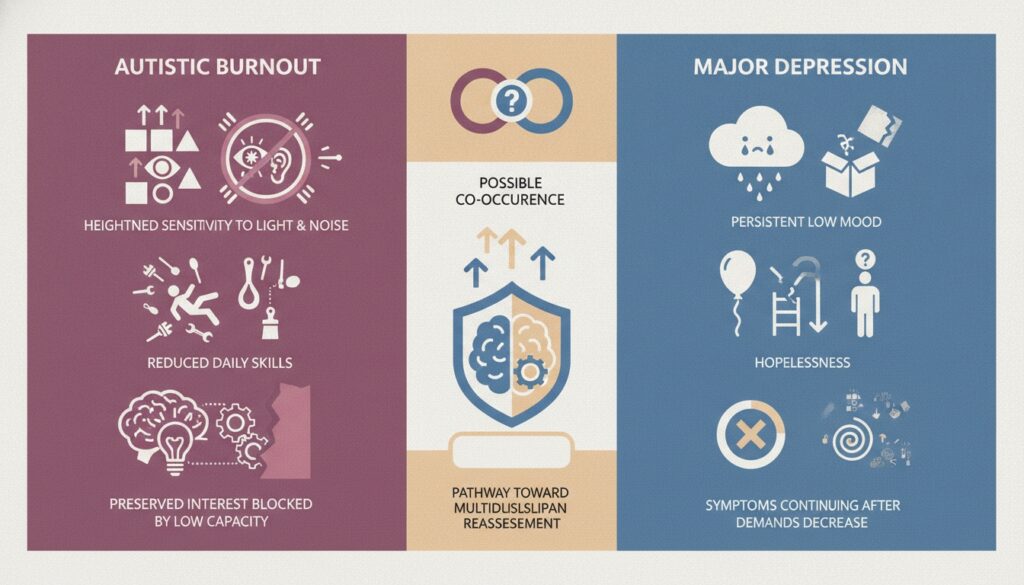
Depression looks different in a few key ways. Persistent hopelessness, a loss of pleasure in things once enjoyed, and low mood that doesn’t lift even after demands are genuinely reduced all point more toward depression than burnout. One study followed an undiagnosed autistic teenager whose depression didn’t budge after several rounds of medication, and the clinicians eventually recognized autism as part of the picture. That doesn’t prove every hard to treat depression is secretly autism, but it’s a solid reason to ask the question, especially in a woman without an intellectual disability.
Both can be true at once, and neither should replace the other. Persistent suicidal thoughts, appetite changes, or a mood that stays low no matter what happens around someone always deserve direct attention, whether or not burnout is also part of the story.
What a Good Adult Autism Diagnosis Includes
A solid adult autism diagnosis rarely rests on one test or one appointment. Adult assessment guidelines recommend pulling from multiple sources: a detailed developmental history, direct observation, self reports, information from people who know the person well when possible, and a careful look at other conditions that could explain the same symptoms.
The Autism Diagnostic Observation Schedule, or ADOS 2, is the tool most people picture when they think of autism testing. It’s useful, but it isn’t a stand alone verdict. A meta analysis of real world referral clinics found pooled sensitivity of 0.88 and specificity of 0.74 for ADOS 2 overall, with specificity dropping further in adult and psychiatric settings. In plain terms, a good result on the ADOS 2 during a brief adult observation should raise questions, not settle them, particularly for someone who has spent a lifetime learning to perform well socially for short stretches of time.
Credentials matter as much as the test itself. Completing ADOS 2 training doesn’t automatically grant someone legal authority to diagnose autism. That authority comes from a state license, typically held by psychologists, psychiatrists, or other physicians whose scope of practice covers diagnosing developmental conditions in adults. If you’re not sure whether your evaluator can legally sign off on a diagnosis, ask directly before you book.
Insurance adds another layer of frustration. Coverage rules written for children with autism, often capped at age 18 or 21, frequently don’t apply to adults at all, and self funded employer plans are commonly exempt from state insurance mandates that might otherwise apply. Before booking anything, it’s worth calling your plan and asking specifically about coverage for an adult psychiatric or psychological diagnostic evaluation, since that phrasing tends to get further than simply asking about autism testing.
That’s exactly why developmental history carries so much weight. Childhood friendships, sensory habits, routines, and communication style tend to reveal patterns a one hour observation simply can’t capture. An evaluator who asks about your childhood, not just your current stress level, is doing the job right.
Why Late Diagnosed Autism in Adults Matters
Getting this right isn’t just an academic exercise. Years spent treating anxiety without addressing chronic sensory overload, or treating depression without recognizing burnout, can leave someone stuck cycling through medications and therapy approaches that were never aimed at the actual problem.
A later autism diagnosis doesn’t erase the anxiety, depression, or BPD that came before it. Those conditions can be real and can exist alongside autism. What changes is the plan: accommodations at work, a treatment approach that respects sensory needs, and, maybe most importantly, an explanation that finally fits a lifetime of feeling like you were doing everything right and still struggling. That kind of clarity, even years late, tends to matter more than people expect.
If you’ve recognized yourself in this pattern of anxiety, exhaustion, or years of diagnoses that never quite fit, you don’t have to sort it out alone. Reach out to the team at Mosaic Wellness & Recovery to learn more about outpatient mental health care and start a conversation with someone who understands adult evaluation.