
Medication vs. Therapy for Anxiety: Which Comes First?

There’s no single right answer for whether medication or therapy should come first for anxiety, because the best starting point depends on your diagnosis, how severe your symptoms are, and how fast you need relief. For generalized anxiety or mild social anxiety, structured therapy alone often works, while panic disorder or more severe symptoms may respond faster when medication is added early, since SSRIs typically need eight to twelve weeks at a working dose to show their full effect. This guide walks through how medication vs therapy for anxiety decisions actually get made, what anxiety treatment options look like in practice, and how to tell if you need medication for anxiety right now.
Medication vs Therapy for Anxiety: Where to Start
The honest answer is that both options work, and picking one over the other is rarely permanent. Guidelines treat cognitive behavioral therapy and SSRIs as equally reasonable starting points for generalized anxiety, panic disorder, and social anxiety, with the choice shaped by your preference, whether you have depression alongside anxiety, and how fast you need change.
What tends to guide the decision in practice:
- How severe your symptoms are and how much they disrupt daily life
- Whether you can access a therapist trained in exposure work or structured CBT within a reasonable time
- Whether you have tried either approach before and how you responded
- Your comfort level with taking a daily medication versus doing weekly behavioral work
A pharmacotherapy review notes that SSRIs and SNRIs are established starting medications for generalized anxiety, panic disorder, and social anxiety, but the same review stresses that medication choice should reflect personal history and tolerance for side effects, not a fixed rule.
Anxiety Treatment Options You Can Choose From
Before comparing medication and therapy directly, it helps to see the full menu. Anxiety treatment options generally fall into three buckets: medication, structured therapy, or a combination of both.
| Factor | Medication (SSRI/SNRI) | Structured therapy (CBT) |
|---|---|---|
| Time to early change | Around 2 to 4 weeks | Often within the first month |
| Time to full assessment | Roughly 8 to 12 weeks at a working dose | Usually 8 to 16 sessions depending on diagnosis |
| Daily effort required | Take a pill, manage side effects | Weekly practice, homework, exposure work |
| Best fit for | Panic symptoms, physical tension, comorbid depression | Avoidance patterns, worry loops, skill building |
For panic disorder specifically, a national treatment guideline describes a standard therapy course as 8 to 16 weekly sessions lasting one to two hours, built around exposure to feared sensations and situations. That is a far more concrete number than the vague idea that therapy just “takes a while.”
General CBT courses, across anxiety conditions, commonly run about 8 to 12 sessions, according to Cleveland Clinic’s overview of the treatment. That said, the number of sessions matters less than whether the therapy includes real behavioral practice, not just talking about feelings.
Do I Need Medication for Anxiety Right Now?
This is often the question people actually want answered, and it deserves a direct response. You likely need medication now, or at least should seriously discuss it with a prescriber, if:
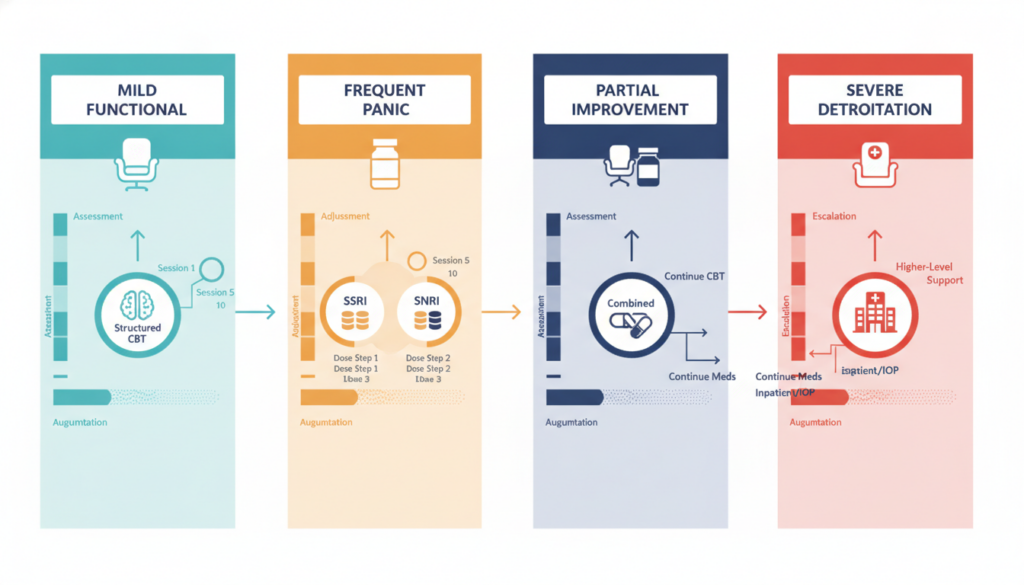
- Your anxiety includes frequent panic attacks that interfere with basic tasks like driving or working
- You cannot engage in exposure therapy because your baseline anxiety is too overwhelming to start
- You have moderate to severe depression alongside your anxiety
- Avoidance has caused significant loss of function, such as missing work or withdrawing from relationships
You may not need medication immediately if your symptoms are mild to moderate, you can attend and engage with weekly therapy, and you are not dealing with frequent panic attacks or major depression. In that case, starting with therapy and reassessing after a few weeks is a reasonable path.
It is worth noting that medication starts slowly on purpose. Early on, SSRIs can temporarily worsen restlessness, sleep, or stomach symptoms, which is one reason doses usually begin low and increase gradually. A regional prescribing guideline recommends checking in within two weeks of starting a medication, then every two to four weeks for the first three months, precisely because early discomfort does not mean the medication has failed.
What Therapy Looks Like in the First Month
If you choose therapy first, or alongside medication, the first month should not be judged by whether your anxiety has disappeared. It should be judged by whether the therapy contains real, active ingredients.
Signs therapy is on track
By around the fourth session, a solid CBT course for anxiety should include a clear formulation of your triggers, defined goals, and actual homework between sessions, not just conversation. For panic disorder, this often means starting exposure to physical sensations that mimic panic, since avoiding those sensations is part of what keeps panic disorder going.
Signs therapy needs adjusting
If a month has passed and there has been no homework, no discussion of avoidance patterns, and no movement toward facing feared situations, that is a signal to raise it directly with your therapist or consider a different approach. Supportive conversation has value, but it is not the same as structured, disorder specific therapy.
The same logic applies to generalized anxiety. Official guidance describes a typical GAD focused therapy course as around ten sessions, built around worry management, tolerance of uncertainty, and gradually reducing reassurance seeking, per the same national treatment framework. Extending sessions well beyond that range has not shown clearly better routine results, which suggests that more weeks are not automatically better if the content stays the same.
Medication vs Therapy for Anxiety: Combining Both
Here is the part that often gets skipped in the “pick one” framing: for a meaningful share of people, the real answer to medication vs therapy for anxiety is both, just not necessarily starting on day one.
A common and well supported pattern looks like this:
- Start with whichever option is more accessible or better matches your symptoms.
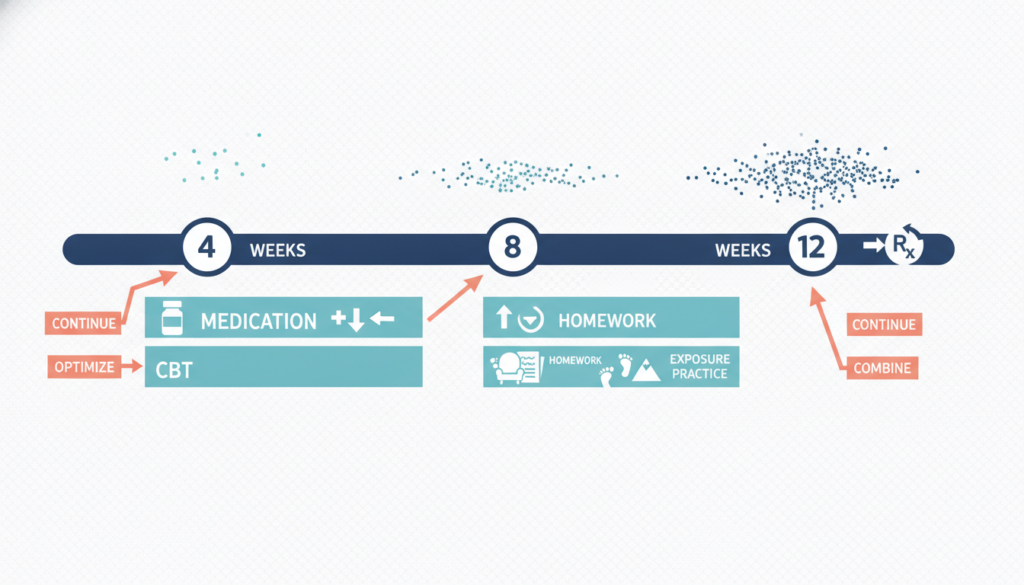
- Check progress around week four to confirm the treatment is actually being delivered at an adequate level, meaning a real dose or real behavioral practice.
- Reassess around week eight for early signs of movement.
- By week twelve, if progress is partial rather than solid, add the second approach rather than just continuing to wait.
Official guidance supports this order of operations. NICE’s treatment recommendations for related anxiety conditions state that when a person does not respond adequately to one approach alone within about twelve weeks, the next step is usually to add the complementary treatment rather than switch blindly or simply keep going unchanged. The logic is straightforward: medication tends to lower baseline physical arousal and panic frequency, while therapy tends to change avoidance, worry patterns, and safety behaviors. Combining them targets both mechanisms at once.
For generalized anxiety and panic disorder specifically, the national anxiety guideline emphasizes aiming for full recovery rather than settling for partial symptom relief, which is part of why clinicians are often encouraged to add a second treatment rather than accept “somewhat better” as a finish line.
Why It Matters: Getting the Order Right
Choosing between medication and therapy is not a one time decision that locks you into a path. It is a starting point that should be revisited on a schedule, roughly at four, eight, and twelve weeks, with a clear question at each checkpoint: is this treatment actually being delivered fully, and is it producing real change.
Getting the order right matters because delays add up. Waiting too long to add a second treatment when the first one is only partly working can mean months of continued impairment that were preventable. On the other hand, jumping to add medication or a new therapist before giving the first approach a fair, full length trial can create unnecessary side effects or confusion about what is actually helping.
One more practical factor deserves mention. Access and cost often shape this decision more than clinical preference does. A health policy review on insurance coverage for mental health notes that plans must generally cover therapy and medication management on comparable terms to medical care, but that does not guarantee a nearby therapist is accepting new patients or that your medication avoids extra authorization steps. If your first choice treatment is not realistically available soon, it makes sense to start with whichever option you can actually begin now, then add the other once access opens up.
The bottom line is this. Medication and therapy are not competitors, they are tools that work through different paths. Start where you can start effectively, track real progress on a defined schedule, and be willing to combine both if one alone is not getting you all the way to feeling better.
If you are trying to figure out whether medication, therapy, or both makes sense for your anxiety, our team can help you sort through the options and build a plan that fits your life. Reach out to learn more about our outpatient programs at Mosaic Wellness & Recovery and take the next step toward feeling steady again.