
Social Anxiety vs. Shyness: How to Tell the Difference

You might wonder if you’re just shy or if something more serious like social anxiety disorder is going on. The clearest answer in the social anxiety vs shyness comparison is duration and impact: true social anxiety disorder involves fear of judgment that lasts six months or longer and disrupts work, school, or relationships. This guide covers the signs of social anxiety disorder, explains social anxiety disorder symptoms, and helps you decide if you’re shy or socially anxious.
Social Anxiety vs. Shyness: The Core Difference
Being shy and having social anxiety disorder can look the same from across a room. Both can involve a racing heart before a party, a preference for small groups, or a habit of hanging back until you feel comfortable. But shyness is a personality trait, not a diagnosis. It shows up as caution around new people, and it usually eases once you get familiar with a situation.
Social anxiety disorder works differently. According to the clinical definition used by mental health professionals, it centers on a marked and lasting fear of being watched, judged, or embarrassed in front of others. That fear has to be out of proportion to the actual risk, and it has to keep showing up across situations rather than fading over time. The situation almost always triggers anxiety, and the person either avoids it completely or pushes through it while feeling intense distress.
Introversion is a separate thing entirely, and it often gets mixed up with both. An introverted person may simply prefer a quiet evening to a crowded one, without any fear of being judged at all. Shyness and introversion can overlap, but neither one requires the core ingredient of social anxiety disorder: a genuine belief that others are about to see something unacceptable and reject you for it.
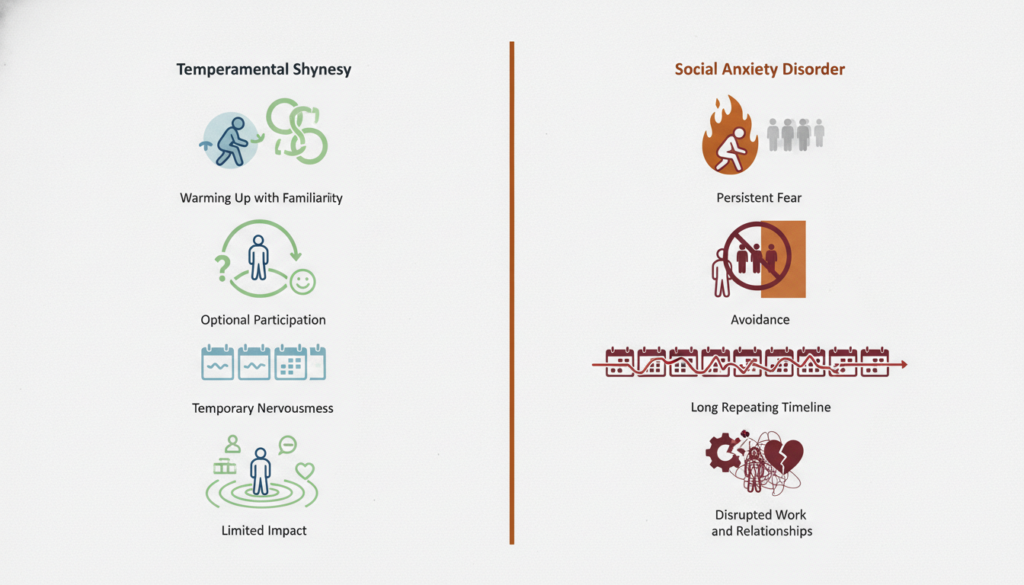
Here’s the part that trips people up. Someone with social anxiety disorder can still show up to the party, give the presentation, or make small talk at work. They might just spend three days dreading it beforehand and replaying every word afterward. Shyness rarely demands that kind of toll.
Signs of Social Anxiety Disorder to Watch For
Since shyness and social anxiety disorder can look alike on the surface, it helps to line them up side by side. A widely used clinical guideline recommends looking at four things together rather than any single symptom on its own: fear, avoidance, distress, and how much the pattern actually gets in the way of someone’s life.
| What to look at | Shyness | Social anxiety disorder |
|---|---|---|
| Trigger | New people or unfamiliar settings | Any situation where others might watch or judge |
| Response over time | Eases once things feel familiar | Stays intense even with repeated exposure |
| Behavior | Can join in, just needs a warm up | Avoids the situation, or endures it with real distress |
| Duration | Comes and goes, often short lived | Persistent, typically six months or more |
| Effect on life | Work, school, and relationships stay mostly intact | Causes real distress or blocks daily life |
Signs of social anxiety disorder often show up as small, easy to miss habits rather than obvious panic. Think of someone who rehearses a two minute update for an hour, avoids eye contact during a conversation, checks their phone constantly at a gathering to look occupied, or has a drink before a work event just to get through it. None of those things scream “disorder” on their own. Together, and repeated over months, they paint a different picture than plain shyness.
It also helps to notice what happens after the situation ends. A shy person might feel relieved once a party is over and move on with their day. Someone with social anxiety disorder often keeps replaying the event for hours, picking apart every word they said and every look they think they caught, a pattern sometimes called post event rumination. That lingering aftermath is one of the clearer signs of social anxiety disorder that a quick glance would miss.
Am I Shy or Socially Anxious? Ask Yourself This
A useful gut check: if judgment weren’t part of the equation at all, would you want to do the thing you’re avoiding? If the honest answer is “not really, I’d rather stay home and I’m fine with that,” you might just be shy, or maybe you’re an introvert who recharges alone. That’s not a problem that needs fixing.
If the answer is “yes, I want to date, make friends, or go for that promotion, but I genuinely believe I’ll be humiliated if I try,” that points more strongly toward social anxiety disorder. The desire is there. This is more common than most people realize. An estimated 12.1 percent of U.S. adults experience social anxiety disorder at some point in their lives. Fear is what’s getting in the way.
Age matters less than people assume. Social anxiety disorder often becomes noticeable during the early teen years, with a typical onset age around 13, though it can also develop later in life after a humiliating event or a big change in social role, like starting a new job that suddenly requires public speaking. So don’t rule it out just because you were an outgoing kid, and don’t assume you’re stuck just because you were shy at nine.
Consider a few everyday comparisons. A shy person feels nervous before a first date but goes anyway and can keep dating over time. Someone with social anxiety disorder might want a relationship badly and still avoid dating for years because the fear of rejection feels unbearable. A shy person dislikes presentations but gets through the required ones. Someone with social anxiety disorder might choose an entire career path just to avoid public speaking, or call in sick on the morning of a talk.
One more question worth asking honestly: what does it cost you to push through? Someone who is shy might feel a flutter of nerves before a meeting and move on with their day. Someone showing real social anxiety disorder symptoms might spend two days over preparing a five minute update, then spend two more days recovering from it. That hidden cost, not just whether you show up, is often the clearest sign of a genuine problem.
Social Anxiety Disorder Symptoms Doctors Look For
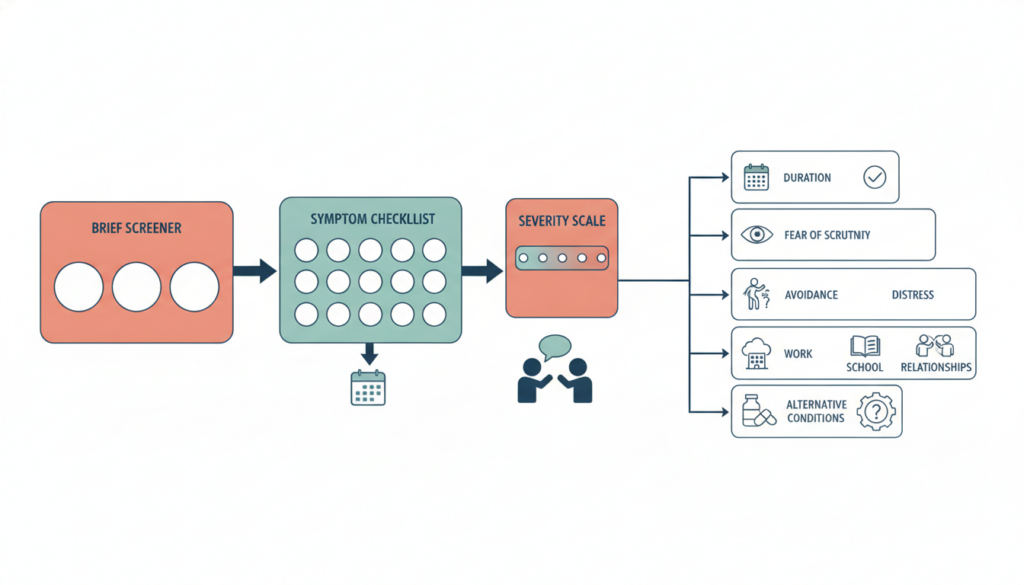
Clinicians rarely sort out social anxiety vs shyness from a single conversation. Many start with short screening tools. The Mini SPIN, a three question scale, is one of the most common. A validation study found that a score of six or higher correctly flagged people with generalized social anxiety about 89 percent of the time, and correctly cleared people without it about 90 percent of the time in the population studied.
A longer tool called the SPIN uses seventeen questions to check for fear, avoidance, and physical symptoms like blushing, shaking, or a racing heart. The psychometric study behind it found that a score of 19 or above reliably separated people with social phobia from those without it. For a more detailed picture, some clinics use the Liebowitz Social Anxiety Scale, which rates fear and avoidance separately across 24 different social and performance situations, and an LSAS scoring guide often treats a score of 30 or higher as worth a closer look.
None of these tools hand out a diagnosis by itself. A positive screen simply means a fuller conversation is worth having, one that covers how long the fear has lasted, how much it’s costing the person day to day, and whether something else, like depression, panic disorder, or a medical condition, might explain the picture better. Screening also helps rule things in rather than out. Many people never mention social fear directly. They show up describing trouble sleeping, stomach problems, or a vague sense of being “bad with people,” and a brief questionnaire can surface the real pattern underneath.
Social Anxiety vs. Shyness: Why the Difference Matters
Getting this right matters because the fix is different depending on what’s actually going on. Someone who is shy might just need practice, time, and maybe a gentle nudge out of their comfort zone. Someone with social anxiety disorder often benefits from structured treatment, most commonly a type of therapy that gradually rebuilds tolerance for feared situations, sometimes paired with medication when fear is severe enough to block that process.
The stakes are real. Left alone, social anxiety disorder can chip away at careers, friendships, dating, and even basic things like going to the doctor when something feels wrong. Under the same clinical definition referenced earlier, the pattern has to cause real distress or get in the way of daily functioning before it counts as a disorder, which is exactly why a quiet personality alone should never be treated as a diagnosis, and why an outwardly capable life should never automatically rule one out either. Plenty of people manage to look fine on the outside while quietly organizing their whole life around avoiding judgment.
If you’ve read this far and recognized more of yourself in the social anxiety disorder symptoms than the shyness column, that’s worth taking seriously rather than brushing off as a personality quirk.
If this sounds like more than shyness, you don’t have to sort it out on your own. Reach out to our team at Mosaic Wellness & Recovery and talk it through with our outpatient mental health program.