
Suicidal Ideation Warning Signs and How to Help Someone

If someone you love is showing suicidal ideation warning signs, the most important thing you can do right now is ask them directly whether they are thinking about suicide. Direct questions do not raise risk, and 988 counselors resolve most contacts through conversation alone, with emergency responders involved in under 2 percent of cases. This guide covers the warning signs, how passive thoughts differ from active ones, and how to help someone suicidal, step by step.
Suicidal Ideation Warning Signs to Watch For
Suicidal thoughts rarely arrive as one dramatic moment. More often, they show up as a pattern of smaller changes that build over days or weeks, and that pattern is easy to miss if you are not looking for it.
Drawing on official guidance, the clearest warning signs of suicidal ideation include talking about wanting to die, feeling hopeless or trapped, feeling like a burden to others, searching for ways to end their life, giving away belongings, saying goodbye in a way that feels final, withdrawing from friends and family, taking unusual risks, sleeping or eating very differently, and drinking or using drugs more than usual.
These signs sort loosely into three groups. Verbal signs are things a person says out loud, such as “everyone would be better off without me.” Emotional signs are shifts in mood, like sudden emptiness, shame, or rage that seem out of proportion. Behavioral signs are changes you can observe, like a person who suddenly cleans out a closet, stops responding to texts, or starts researching methods online.
None of these signs alone proves that someone will attempt suicide. What matters more is a new or worsening pattern, especially when several signs cluster together or shift sharply within a short window. A person who has always been quiet is different from someone who was talkative last month and now avoids everyone after weeks of hinting that they are a burden. Context and change matter as much as any single comment.
If something feels off, treat that feeling as reason enough to check in. Waiting for certainty before acting is one of the most common and costly mistakes loved ones make, because certainty rarely arrives before it is needed.
Passive vs Active Suicidal Ideation Explained
Not all suicidal thoughts look the same, and the difference matters for how you respond next.
Passive suicidal ideation usually sounds like a wish to be dead or a wish to disappear, without any stated plan to act on it. Someone might say, “I wish I would not wake up,” or “It would be easier if I were not here,” while denying any thought of actually killing themself. This kind of thinking is common during grief, chronic pain, exhaustion, and depression, and it deserves care even though it sounds less alarming than a stated plan.
Active suicidal ideation goes further. It involves thoughts of killing oneself, and severity ranges widely, from a vague thought with no method in mind, to a chosen method without a plan, to full intent with a specific plan and timeline. Clinical tools such as the Columbia Severity Scale separate these levels clearly, moving step by step from a simple wish to be dead, through active thoughts, a chosen method, some intent to act, and finally a specific plan paired with intent.
The line between passive and active thinking is not fixed, and it can move quickly. A person can shift from one to the other within hours, especially during heavy drinking, a panic episode, a sleepless stretch, or a sudden loss. Real time research on people in psychiatric care found that passive and active ideation were closely linked for most participants, though the strength of that link varied a great deal from person to person, and for some, active thoughts were driven more directly by anxiety or hopelessness than by a slow buildup from passive wishes.
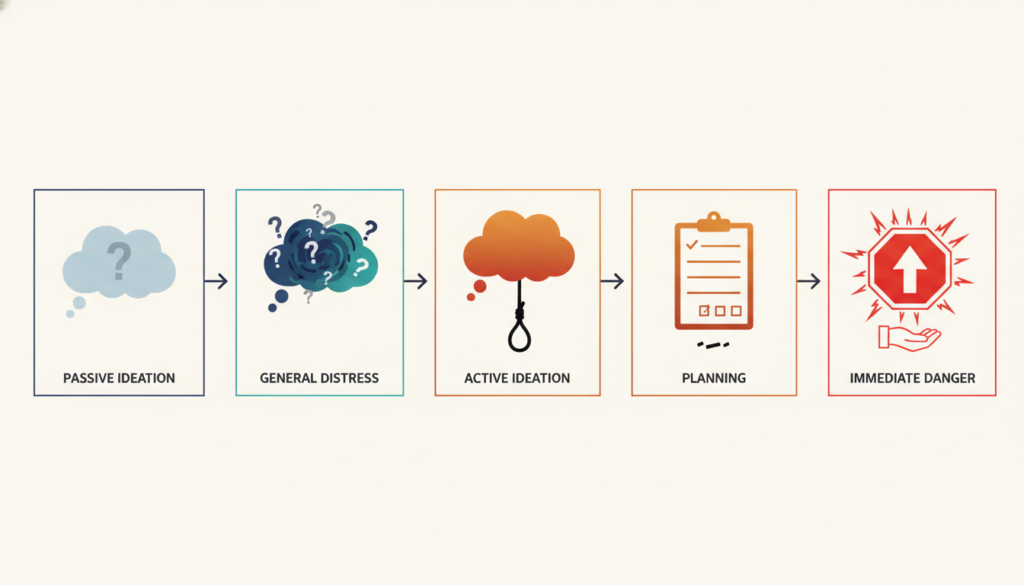
This is exactly why a passive comment should never be brushed off as harmless. It deserves the same direct follow up as an active statement, because you cannot know which one you are dealing with until you ask.
How to Ask Directly About Suicidal Thoughts
Asking directly feels uncomfortable for almost everyone, but it is one of the safest things you can do. Vague questions like “you are okay, right?” give a person an easy way to tell you what they think you want to hear. A direct question gives them permission to tell the truth instead.
Start with something grounded in what you have observed: “I have noticed you seem overwhelmed lately, and I want to ask you directly, are you thinking about suicide?” If the answer is yes, unclear, or avoided, follow up using the same structure clinicians rely on in a clinical assessment method built around frequency, method, timing, access, and intent.
Useful follow up questions include:
- Are you having these thoughts right now?
- Do you have a plan for how you would do it?
- Do you have access to what you would use?
- Have you taken any steps to prepare?
- Have you tried to hurt yourself before?
- Would you be willing to call 988 with me right now?
Listen without arguing, correcting, or rushing to reassure. Avoid saying things like “you have so much to live for” or asking someone to promise they will not act. A promise is not a safety plan, and it is not a substitute for real support and follow up care.
How to Help Someone Suicidal Right Now
Once you know someone is thinking about suicide, the next move is to reduce danger and connect them to support, not to fix everything yourself in one conversation.
Stay with the person, or make sure another trusted adult does, especially if they cannot commit to staying safe on their own for the next few hours. Ask directly about anything in the home that could be used to end their life, and work together to move it somewhere else for now. This might mean a family member holding onto medication temporarily, or a firearm moved to another location until things settle. This step, often called means safety, buys time during the exact window when a crisis is most dangerous, and it works even when nothing else feels within your control.
Build a short safety plan together rather than handing someone a printed list. The widely used Stanley Brown plan walks through six steps: personal warning signs, things the person can do alone to calm down, people or places that offer distraction, people they can tell honestly that they are struggling, professional contacts including 988, and specific changes to make the environment safer.
Offer to call or text 988 together, or sit with them while they do it themselves. You do not need to have the right words. Being present, calm, and willing to stay close matters more than saying anything perfect, and it often matters more than anything a screening tool can measure.
911 or 988: Which One Do You Call
This is the question that stops a lot of people cold, and the answer is more straightforward than it feels in the moment.
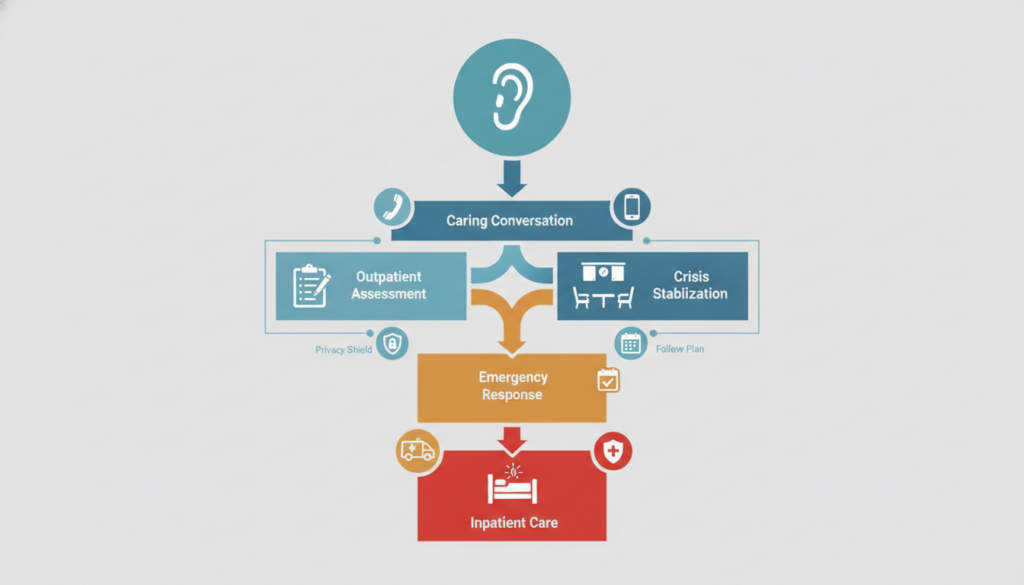
Call 911 or go to an emergency room when a suicide attempt is happening, when someone has taken an overdose, when they have an immediate plan and access to a lethal method, or when there are signs of a medical emergency such as unconsciousness or serious injury. These situations need physical intervention right away, and there is no reason to wait or second guess that call.
Call or text 988 crisis line services when someone is having suicidal thoughts, feels hopeless, or is in emotional crisis, but there is no attempt underway and no danger that threatens life right this minute. According to the Substance Abuse and Mental Health Services Administration, 988 connects callers with a trained counselor who offers support, safety planning, and referrals, and contacting the line does not automatically send police or trigger a hospital stay.
If you are ever unsure which to choose, calling 988 first is a reasonable default. A counselor can help you sort out whether the situation needs a higher level of response, and can bring in emergency services if the danger turns out to be more immediate than it first appeared.
Suicidal Ideation Warning Signs After a Crisis Passes
Getting through the worst moment is not the finish line. The period right after a crisis, whether that involved a hospital stay, a hard conversation, or a call to 988, is one of the riskiest windows a person will face.
Research described by the Substance Abuse and Mental Health Services Administration found that suicide death rates in the week after a psychiatric hospital discharge run about 300 times higher than the rate in the general population, which is part of why prompt follow up care matters so much during this stretch. The same logic applies outside a hospital setting too. A person who reached out for help once may not reach out again on their own the next time things get hard.
Watch for the same warning signs of suicidal ideation returning in the weeks that follow, especially renewed withdrawal, sleep changes, and fresh talk of being a burden. Keep the safety plan somewhere visible and update it as things change. Check in without waiting for the person to ask first, and if they are struggling to schedule that next appointment, offer to help set it up yourself.
Why Suicidal Ideation Warning Signs Matter
None of this requires you to become a therapist or predict the future. It requires a willingness to notice, ask, and act on what you see, instead of hoping the situation resolves quietly on its own.
Suicidal ideation warning signs are not a verdict. They are information, and information you can use. A wish to disappear, a comment about being a burden, a sudden giving away of belongings, none of it guarantees an outcome, but each one is a real opening to step in before things get worse. Whether the thoughts are passive or active, and whether the right next call is 988 or 911, the underlying task is the same: pay attention, ask plainly, and stay close.
People who get through a suicidal crisis and go on to build a different life almost always point to the same thing: someone noticed, someone asked, and someone stayed near enough to help them reach the next step. You can be that person, and you do not have to carry it alone.
If you or someone you love is dealing with suicidal thoughts, depression, or a crisis that feels too big to handle on your own, reach out to a licensed team at Mosaic Wellness & Recovery that can meet you where you are through outpatient mental health services and help you build a plan for what comes next.