
Warning Signs of Suicidal Ideation and How to Respond

Warning signs of suicidal ideation range from a quiet wish to disappear to active thoughts about a specific method, and knowing the difference shapes how urgently you respond. Research shows most unplanned attempts happen within a year of the first thought, so a denied plan is not proof someone is safe. This guide covers passive vs active suicidal ideation, how to help someone suicidal, and when to get emergency support.
Warning Signs of Suicidal Ideation to Watch For
Suicidal ideation is not just one thing. Clinicians describe it as a continuum, laid out clearly in a widely used suicide severity scale, that starts with wishing you were dead and can move all the way to having a method, a time, and the intent to use it.
At the mild end, suicidal thoughts warning signs can look almost invisible. Someone might say they wish they could just disappear, stop feeling anything, or not wake up. They might pull away from friends, sleep more or less than usual, lose interest in things they used to enjoy, or start giving away belongings without a clear reason.
At the more urgent end, the signs get sharper. A person might talk about a specific way they would die, research a method online, buy or gather something they could use, write goodbye messages, or say they do not know if they can stop themselves. A controlled look at people hospitalized after an attempt found that in the hours before, many showed a mix of talking about death, getting affairs in order, drinking, conflict with someone close, and a rising sense of being a burden, a pattern described in an acute warning sign study.
No single sign proves someone will act. A cluster of them, especially if new or getting worse, is reason enough to ask a direct question rather than wait and see.
Passive vs Active Suicidal Ideation Explained
The passive vs active suicidal ideation split is one of the first things a clinician tries to sort out, and it helps to understand it even outside a clinical setting.
What Passive Ideation Sounds Like
Passive ideation is a wish to be dead or to stop existing, without a stated desire to cause your own death. It sounds like “I wish I would not wake up” or “It would be easier if I were not here.” It often shows up with grief, chronic pain, exhaustion, or depression. It is not harmless, but it does not automatically mean someone is about to act.
What Active Ideation Sounds Like
Active ideation means the person has thought about killing themselves. That can range from a vague thought with no method in mind, to a specific method, to real intent to act, to a full plan with a time and a place. A study following young people in psychiatric emergency care found that the strength and controllability of ideation, not just whether a past attempt happened, predicted who went on to attempt again, based on results from an emergency psychiatric study. How strong the pull feels, and whether someone can push it away, matters as much as the label passive or active.
The honest answer to which one is more dangerous is that it depends. Passive thoughts that grow stronger every week can outrun active thoughts that stay mild and are openly discussed with a therapist.
Why No Plan Does Not Mean No Danger
A common mistake is treating “do you have a plan” as the only question that matters. It is an important question, but a clean no does not rule out risk.
Plans are not always made ahead of time. A federal reference guide on suicide risk notes that a large share of attempts are unplanned, and that most unplanned attempts happen within the first year after suicidal thoughts begin, according to VA assessment guidance. People also skip a stated plan because they are intoxicated, in shock, ashamed, afraid of being hospitalized, or simply have not organized their thinking that far. None of that means they are safe.
What tends to matter more in the moment is whether the person can reach something lethal right now, whether they are intoxicated or extremely agitated, and whether they have started doing things like giving away possessions or writing notes. Those signs can point to more danger than a calmly stated, detailed plan the person has no real way to carry out.
What Intent and Access to Means Add
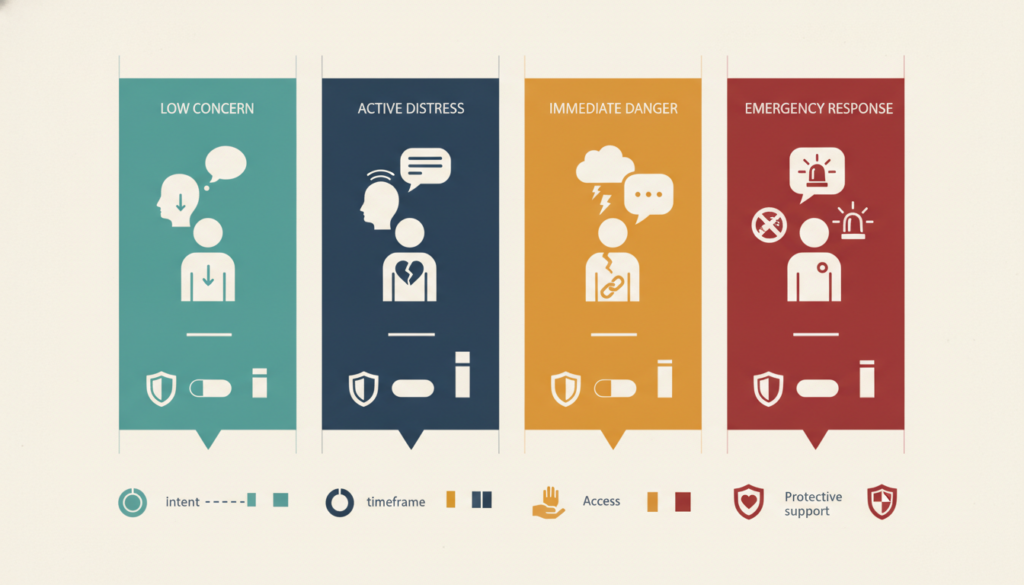
Two questions cut through a lot of noise: does the person expect they might act, and can they get to something lethal quickly. Intent is not always a clear yes. Someone might say part of them wants to live but they are scared of what they might do if left alone tonight. That kind of answer deserves more concern, not less.
Access to means changes the math because it shortens the gap between an urge and an action. Emergency medicine guidance recommends asking plainly about access to firearms and medication, and suggests storing firearms away from the home during a crisis whenever that is legal and possible, a practice described in emergency medicine guidance. If a firearm cannot leave the house, it should be locked, unloaded, and stored apart from its ammunition, with the person at risk unable to reach the keys.
Timing matters too. “I have thought about this for months but nothing is different today” reads very differently from “I do not know if I can make it through tonight.” The second answer, even without a named method, calls for action now.
How to Help Someone Suicidal Right Now
If you are trying to figure out how to help someone suicidal, the first and most useful step is also the one people avoid most: asking directly.
Ask the Direct Question
A gentle opening helps, but the core question should be plain. Something like, “Are you thinking about killing yourself?” People often worry that asking will put the idea in someone’s head. That fear is not backed by evidence. A federal fact sheet states plainly that asking does not create suicidal thoughts and can open the door to help, based on current NIMH guidance. A review in a major psychology journal likewise found no rise in suicidal thinking among people asked directly, and some groups even reported feeling better afterward, a pattern confirmed by a psychological medicine review.
What to Say and What to Avoid
Once someone tells you they are struggling, how you respond matters. Thank them for telling you. Say you take it seriously. Ask what would help right now instead of jumping to fixes. Skip lines like “you have so much to live for” or “promise me you will not do anything.” They can sound dismissive, and a promise is not the same as a plan for staying safe.
Do not leave someone alone if they have current thoughts, a way to act on them, and no clear reason to trust they will stay safe. Work on cutting off access to whatever they might use, whether that is medication, a weapon, or anything else specific to their situation.

Warning Signs of Suicidal Ideation and Care Level
Not every warning sign calls for the same response. The goal is matching your response to how close someone seems to acting, not treating every disclosure the same way.
| Situation | What it looks like | What to do |
|---|---|---|
| Passive thoughts, no plan, stable support | Wishes to disappear, no method, willing to talk | Schedule a mental health visit soon, check in often |
| Active thoughts, no clear plan, some risk factors | Talks about death, drinking more, pulling away | Same day evaluation, bring in a trusted person |
| Plan, intent, or access to a lethal method | Specific method, timeline, giving things away | Call 988 or go to an emergency department now |
| Attempt in progress or just happened | Injury, overdose, cannot be kept safe | Address safety first, then call 911 or emergency services |
Two resources are worth knowing before you need them. The 988 crisis line offers call, text, and chat support for anyone in a mental health or substance use crisis, and can connect a person to local help without automatically bringing in police. You can borrow the same logic clinicians use informally: what is happening now, why now, what could make it worse tonight, and what would actually make things safer.
Building a Safety Plan That Works
A safety plan beats a vague promise every time. Instead of asking someone to swear they will not act, work with them to write down what they will actually do if things get worse.
A workable plan usually covers personal warning signs, things the person can do alone to get through a bad hour, people or places that offer distraction, specific people to call, and professional contacts including 988. The safety planning intervention built by researchers Stanley and Brown follows this exact structure, and it works best when it is written in the person’s own words rather than filled out like a form.
The plan should also spell out how to make the environment safer for a while. That might mean a friend holds onto medication for a few days, a firearm gets stored somewhere else for now, or someone agrees not to drink alone this week. These steps do not solve the pain underneath, but they buy time, and time is often what a crisis actually needs.
Why Responding Well Matters
The period right after a crisis is when people are most likely to fall through the cracks. Guidance for emergency departments notes that risk stays highest in the first month after a hospital stay or emergency visit, and that a large share of patients never make it to their first outpatient appointment, a pattern described in an emergency department guide. That is exactly why a phone call to check in, a ride to an appointment, or a text a few days later can matter as much as the first conversation.
Getting the warning signs right, telling passive thoughts apart from active ones, and knowing when to escalate will not remove every risk. But it gives you something better than guessing. It gives you a plan, a next step, and a reason to believe that showing up for someone, even imperfectly, makes a real difference.
If you or someone you love is dealing with suicidal thoughts, professional support can turn a shaky moment into a plan that actually holds. Reach out and explore outpatient care built around mental health and substance use together.