
What Is a 1013 Hold in Georgia? Timeline and Next Steps

A 1013 hold in Georgia can feel confusing when a loved one is taken for an emergency mental health evaluation and no one explains how long it will last. In practice, the receiving facility has about 48 hours, excluding weekends and holidays, to examine the person and decide the next step. This guide explains the real timeline, how to start the process, and what PHP or IOP step down care looks like afterward.
What Is a 1013 Hold in Georgia?
Form 1013 is the certificate that authorizes emergency transport to a hospital or crisis center for a mental health evaluation. Georgia’s behavioral health agency describes the emergency admission process as beginning with this certificate, not ending with it. Signing a 1013 does not mean a person will be committed, diagnosed with anything specific, or held for months. It means a qualified clinician believes the person needs an urgent evaluation right away, and it sets a legal and clinical process in motion.
To sign a 1013, a clinician has to believe the person has a mental illness that creates a real and immediate danger, not just a hard day or a disagreement with family. Georgia’s legal standard, described in involuntary hospitalization guidance, generally requires a substantial and imminent risk of harm to self or others, or an inability to protect one’s own health and safety that has become life threatening. Chronic symptoms, poor choices, or refusing treatment are not enough on their own.
It helps to know what a 1013 is not. It does not guarantee a hospital bed at a specific facility, a particular diagnosis, or months of confinement. It also is not the same as Form 2013, which Georgia uses for addiction related crises rather than mental illness. A 1013 simply opens the door to an evaluation. What happens next depends entirely on what the examining clinician finds once the person actually arrives.
How to 1013 Someone in Georgia
Family members cannot complete a 1013 on their own, and that surprises a lot of people. The certificate has to come from a qualified clinician, such as a physician, psychologist, licensed clinical social worker, or licensed professional counselor, who has personally examined the person within roughly the last two days. That is why the fastest route into this process is usually a phone call rather than a form you fill out at home.
The Georgia Crisis and Access Line, reachable at 1 800 715 4225, or by calling or texting 988, is built for exactly this moment. Dispatchers can talk through what is happening, send a mobile crisis team to assess the person in place, or help locate an open bed, and Georgia’s crisis system overview notes that this line runs around the clock, every day of the year. A mobile crisis visit is not automatically a 1013. It is a clinical assessment that may lead to voluntary help, a bridge appointment, or, if the danger is real and immediate, a certificate.
If no clinician is available and the danger is not immediate, a probate court petition is another route, though it moves slower and the exact steps vary by county. And if there is an active threat right now, such as a weapon in hand, an overdose, or violence already happening, call 911 first. A 1013 can follow once the scene is safe, but it should never delay an emergency response.
How Long Can You Be Held on a 1013 in Georgia
Once someone arrives at an emergency receiving facility, the clock that matters most is the physician examination deadline. Georgia’s rules for these facilities, described in the emergency facility rules, require a physician to examine the patient as soon as possible and, in every case, within 48 hours of admission.
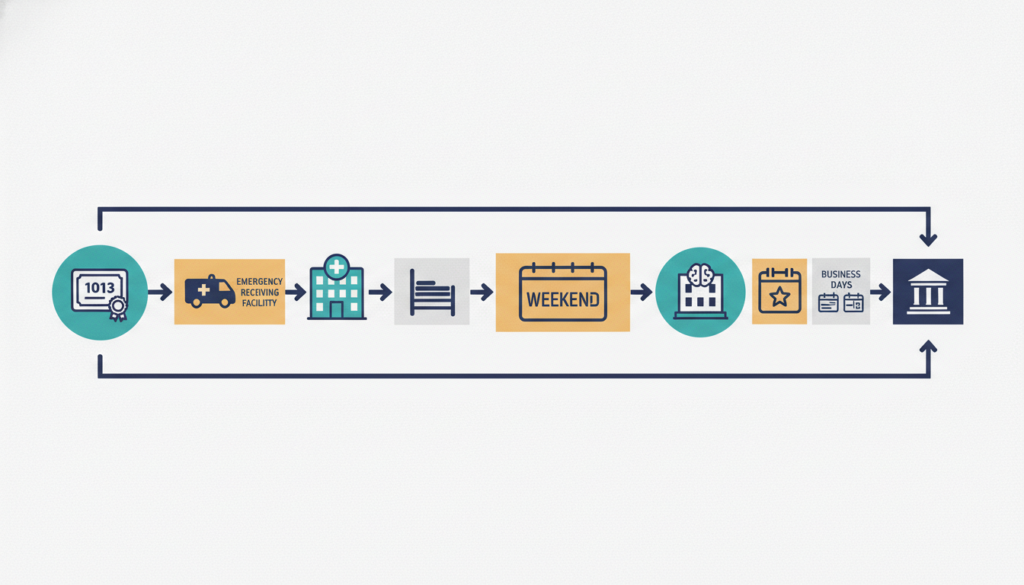
Here is the part most people miss. Those 48 hours are counted only on business days. Saturdays, Sundays, and legal holidays do not count toward that deadline. So a person admitted Friday afternoon might not reach the 48 counted hours until sometime Wednesday, since the whole weekend gets set aside from the calculation. That gap is not a mistake or a violation. It is simply how the deadline gets measured, and it explains why the popular phrase “72 hour hold” almost never matches what actually happens on the calendar.
If the examining physician believes more evaluation is needed, the next document is Form 1014, a certificate authorizing transfer to an evaluating facility. Georgia guidance on inpatient hospitalization steps states that a person is usually moved to the evaluating facility within 24 hours after that certificate gets signed, and the 1014 transfer form itself records both the admission time and the examination time.
From there, the evaluating facility has up to five business days to decide whether the person can be discharged, will accept voluntary treatment, or needs a court ordered path. If the case moves to probate court, the same guardianship division records show that an initial order for involuntary inpatient treatment can last up to six months, which is far longer than the emergency stage that started it all. The table below lays out the whole sequence in one place.
| Stage | What Happens | Typical Timing |
|---|---|---|
| Form 1013 | Certificate authorizes transport for evaluation | Usable for transport up to about 7 days |
| ERF examination | Physician examines the patient | 48 hours, weekends and holidays excluded |
| Form 1014 transfer | Move to an evaluating facility | Within 24 hours of certification |
| Evaluating facility | Decide on discharge, voluntary care, or court petition | Up to 5 business days |
| Probate court order | Judge decides on involuntary treatment | Initial order up to 6 months |
What Happens After the ERF Examination Ends
Once the physician finishes the exam, there are really three ways this can go. The person might be discharged if they no longer meet the legal standard for involuntary care, even if they arrived in real crisis just a day earlier. They might agree to stay voluntarily, which changes their legal status and gives them more say over their own discharge going forward. Or the physician might complete Form 1014 and move the person toward further evaluation, which starts the timeline described above.
None of these outcomes should depend on whether a bed happens to be open somewhere else. The decision is supposed to rest on clinical need, current risk, and what supports actually exist for that person, not on which option is easiest to arrange that afternoon.
PHP and IOP in Georgia After Hospitalization
For many people, the safest next step after a 1013 hold is not another hospital stay. It is a structured outpatient program. Federal rules define both levels by intensity. A Partial Hospitalization Program is built for someone whose plan of care calls for at least 20 hours a week of therapeutic services, which in practice usually means most weekdays from morning into early afternoon for two to four weeks. An Intensive Outpatient Program steps that down to a minimum of nine hours a week, still enough structure and accountability to matter while someone returns to work or family life.
PHP and IOP intake is not always instant, and families should plan for that honestly. Getting a slot usually depends on insurance approval, a clinical screening, open capacity, and transportation, so the wait can range from a same day assessment to a week or two before treatment truly starts. A discharge plan that just says call the program Monday is much weaker than one that confirms an actual appointment, with a program that has already agreed to take the person, before anyone leaves the building.
Step Down Care After a Psychiatric Hold
Step down care after a psychiatric hold means matching the next setting to how much support someone actually needs, rather than defaulting to whatever is easiest to arrange on short notice. Georgia’s crisis stabilization units, governed by adult crisis unit rules, operate every day of the year and are meant to serve as a shorter, less restrictive alternative to a full inpatient stay when someone needs more than outpatient care but not necessarily a hospital bed.
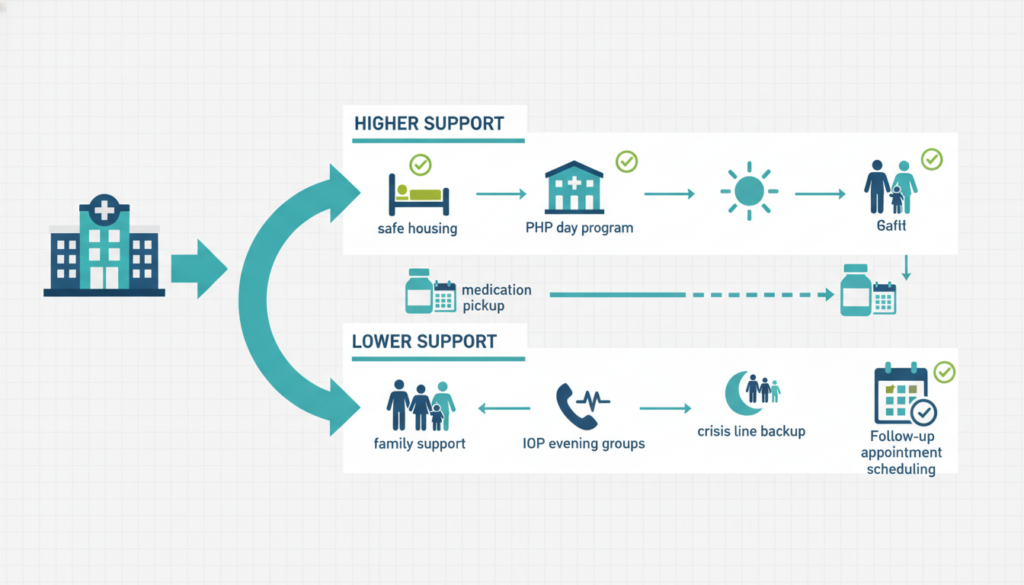
The riskiest moment is often the gap between discharge and the first real appointment, especially when that gap falls over a weekend. The Georgia Crisis and Access Line and its mobile crisis teams can fill that space with a phone check in, an in person visit, or help finding an open slot right away, rather than leaving someone with nothing but a number to try later. Federal discharge planning guidance, summarized by the case management association, makes a similar point directly: the destination after discharge should match clinical need and the person’s own goals, not whichever option is fastest to write down on a chart.
Building a Safe Discharge Plan
A solid discharge plan answers a few plain questions before anyone walks out the door. Where will this person sleep tonight, and is that place actually safe. How will they get their medication today, not sometime next week. Is there a real appointment already on the calendar with a program that has agreed to take them, or just a phone number and a hope. Who else knows the safety plan, assuming the person agrees to share it. And what is the backup plan if things get worse before that first appointment arrives.
Families often want to help but are not sure how much they are allowed to know or do. With the person’s consent, providers can loop in a parent, partner, or close friend who can watch for warning signs, keep track of appointments, and make sure medication actually gets picked up and taken as prescribed.
Why This Timeline Matters
Knowing the real timeline changes how a family experiences this whole process. A weekend delay does not mean something has gone wrong, and a fast discharge does not mean the danger has fully passed. What actually protects someone is a clear next step, confirmed before they leave the facility, paired with a program that fits how much support they need right now rather than whichever option happens to have an opening that day. Georgia’s system, from the crisis line down to local PHP and IOP programs, is built to offer exactly that kind of bridge, as long as someone knows to use it.
If you are trying to sort out what comes next after a 1013 hold in Georgia, you do not have to plan it alone. Reach out to Mosaic Wellness & Recovery and explore outpatient programs built to help someone land safely on the other side of a crisis.