
What Is EMDR Therapy and How Does It Work for PTSD?

EMDR therapy is a structured psychotherapy that helps people process distressing memories through guided eye movements, and it is one of the most studied treatments for PTSD. In a 2025 review, people who tried EMDR were more than twice as likely to lose their PTSD diagnosis than those who simply waited for treatment. This guide walks through how EMDR works, what the evidence shows, and how to know if it might fit your situation.
What Is EMDR Therapy?
EMDR stands for Eye Movement Desensitization and Reprocessing. It is a trauma focused psychotherapy built on the idea that distressing memories can get stuck in the nervous system in a way that keeps producing flashbacks, nightmares, and fear responses long after the danger has passed. The model behind it, called Adaptive Information Processing, holds that trauma memories are stored along with the sensations, emotions, and beliefs present at the time of the event, and that guided reprocessing helps the brain file those memories away in a less distressing form.
Unlike many trauma therapies, EMDR does not usually ask you to describe the traumatic event out loud in long detail. Instead, you hold an image or moment tied to the memory in mind while a therapist guides your attention with side to side eye movements, taps, or tones. The national PTSD center describes EMDR as one of the most researched treatments for posttraumatic stress disorder, with dozens of controlled trials behind it.
People often ask whether this counts as hypnosis or memory recovery work. It does not. You stay awake and aware the entire time, and the goal is not to dig up buried memories but to reduce the distress attached to memories you already have.
How Does EMDR Therapy Work?
EMDR works by pairing a difficult memory with a present moment activity, usually eye movements, that keeps part of your attention anchored in the here and now. This dual focus seems to help the brain reprocess the memory instead of simply reliving it over and over.
Treatment usually organizes around three types of targets: past memories that still feed current symptoms, present triggers that set off fear or panic, and future situations where you want to respond differently. A therapist works with you to choose specific memories in each category, then moves through them across a series of sessions, checking in on how much distress each one still carries as treatment goes on. Over time, a memory that once felt overwhelming often starts to feel more like a fact from the past rather than something happening right now.
The Eight Phases of EMDR for Trauma
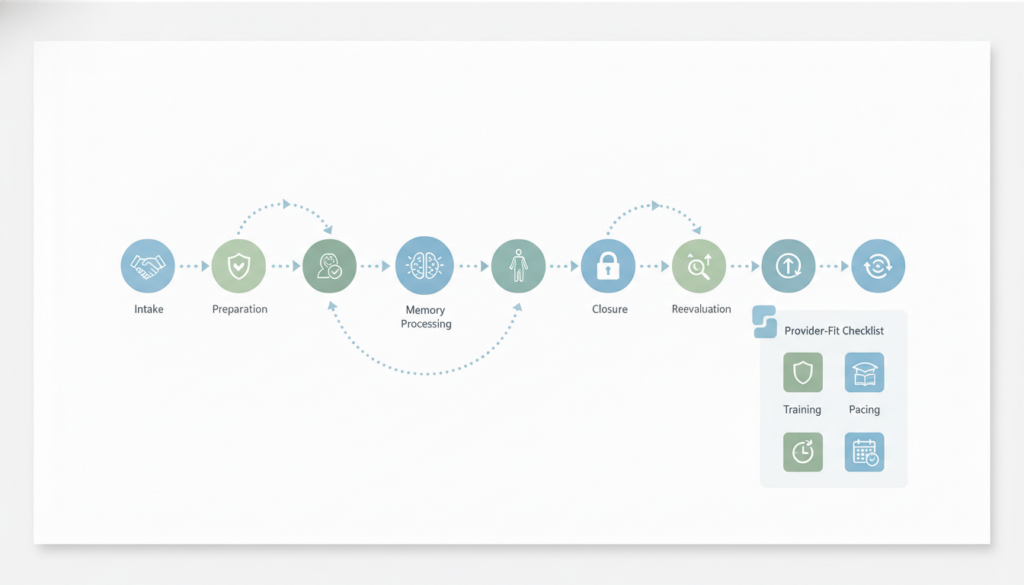
A full course of EMDR for trauma runs through eight phases. Some sessions cover only part of one phase, especially early on, and a skilled therapist moves back and forth between phases rather than rushing forward on a fixed schedule.
| Phase | What happens |
|---|---|
| History taking | The therapist reviews your trauma history, symptoms, and current safety |
| Preparation | You learn grounding skills and what processing will feel like |
| Assessment | You and the therapist define one target memory in detail |
| Desensitization | You focus on the memory during sets of eye movements or taps |
| Installation | A more adaptive belief is strengthened in place of the old one |
| Body scan | You check for leftover tension or discomfort tied to the memory |
| Closure | The session ends with grounding, even if processing is not finished |
| Reevaluation | The next session checks what has changed since the last visit |
The eight phase overview published by the American Psychological Association outlines this same structure as the standard way EMDR is delivered in practice. Notice that only two of the eight phases involve active memory processing. The rest are about preparation, safety, and follow through, which is a big part of why EMDR looks different in real sessions than it might sound online.
Is EMDR Therapy Backed by Research for PTSD?
Yes, most major clinical guidelines list EMDR among the recommended treatments for adult PTSD. The national PTSD center notes that EMDR carries the strongest recommendation level in guidelines from the VA and Department of Defense, the International Society for Traumatic Stress Studies, and Phoenix Australia. Britain’s NICE guidance also recommends EMDR for adult PTSD, though it originally focused that recommendation on non combat trauma more than three months old, partly because fewer studies existed in combat related cases at the time.
The American Psychological Association takes a more cautious stance in its 2025 update, placing EMDR in a second tier below three other trauma focused therapies. That does not mean the group found EMDR ineffective. Its guideline summary describes EMDR as effective but says the supporting evidence was less complete across outcomes such as long term functioning and dissociation.
On the numbers, a 2025 review of 12 randomized trials covering 690 adults found that EMDR produced a large drop in PTSD symptoms compared with waiting for treatment, and more than doubled the odds that someone would no longer meet criteria for PTSD by the end of care. A separate trial comparison of 71 trials found EMDR and trauma focused CBT were the two treatments most clearly better than waiting lists, with neither one reliably beating the other. So EMDR for PTSD looks roughly as effective as other leading trauma therapies rather than clearly superior to them, and that is actually good news because it means you have real options.
How Does EMDR Compare to Other PTSD Treatments?
EMDR belongs to a group of trauma focused therapies that also includes cognitive processing therapy, prolonged exposure, and trauma focused CBT. Head to head studies generally show these treatments performing in a similar range rather than any single one pulling far ahead. A comparison study found EMDR produced somewhat larger reductions in trauma symptoms and anxiety than standard CBT, though results varied a good deal from study to study, so this should be read as a modest signal rather than proof of a clear winner.
In practice, the differences between EMDR and other trauma focused therapies often matter less than fit. EMDR generally asks less of you in terms of detailed verbal retelling and written homework compared with prolonged exposure or cognitive processing therapy. That can make it appealing if talking through the event in detail feels overwhelming. On the other hand, someone who prefers a structured, thought based approach to challenging trauma related beliefs might do just as well, or better, with cognitive processing therapy. Neither path is automatically the right one, which is exactly why a good assessment matters more than a brand name.
What to Expect in an EMDR for PTSD Treatment Plan
For a typical adult with PTSD following a single traumatic event, treatment usually runs as weekly individual sessions of up to 90 minutes over about three months, based on VA guidance. NICE suggests 8 to 12 sessions as a common range, with more added for people who have lived through multiple traumas.
Timelines vary quite a bit in practice. Someone dealing with childhood abuse, ongoing danger, or serious dissociation may need considerably longer, including extra time in the preparation phase before any memory work begins. A responsible therapist explains this early rather than promising a fixed number of sessions.

It is common to feel more emotional, tired, or unsettled for a day or two after a processing session. Vivid dreams, brief spikes in anxiety, or new memories surfacing between sessions can happen and usually settle on their own. What is not normal, and should prompt a call to your therapist, is distress that keeps building, new or worsening thoughts of self harm, or an inability to feel steady again before your next appointment.
Who Might Benefit from EMDR for Trauma
EMDR for trauma has been studied across a wide range of people, not only those with one clear traumatic event. A randomized trial of 155 adults with PTSD and a psychotic disorder found that standard EMDR was effective, safe, and workable compared with a waiting list, with gains still holding six months later. That finding matters because clinicians once assumed psychosis automatically ruled out trauma processing altogether.
Even so, EMDR is not a fix that works the same way for everyone, especially with complex trauma. People with long histories of childhood abuse often carry difficulties beyond core PTSD symptoms, including trouble regulating emotion, harsh self judgment, and unstable relationships. Reducing flashbacks and nightmares does not automatically resolve those wider struggles, so treatment for complex trauma often calls for a longer, more individualized plan built around safety and steady pacing. If you are dealing with ongoing danger, severe dissociation, active suicidal thoughts, or unmanaged substance use, look for a therapist with specific training in complex trauma rather than assuming any EMDR provider will do.
How to Find a Qualified EMDR Provider
Because EMDR is more than a technique, the therapist delivering it matters as much as the method itself. Ask any prospective provider about their license type, their formal EMDR training, and how much experience they have with your specific type of trauma. A good therapist will also explain how they plan to pace treatment, what they watch for if you start to feel worse, and how they handle safety concerns such as self harm risk or severe dissociation.
Be cautious of anyone who promises a quick fix in just a session or two, or who moves straight into detailed memory work before learning your history and current safety. Trauma processing can bring up strong feelings, and a competent EMDR provider prepares you for that rather than rushing past it. If something feels off during your first meeting, it is fair to keep looking until you find a clinician who takes your safety and pacing seriously.
Why It Matters
Choosing a trauma therapy is not really about finding the single best proven method online. The strongest takeaway from the research is that EMDR therapy, cognitive processing therapy, prolonged exposure, and trauma focused CBT all reduce PTSD symptoms in similar ranges, and the right fit depends on your history, your comfort with different formats, and the skill of the person treating you. What matters most in practice is finding a licensed clinician trained specifically in EMDR who takes time to assess your safety, paces the work to what you can handle, and checks in honestly about what is and is not helping.
If PTSD or trauma symptoms are getting in the way of your daily life, you do not have to sort through the research alone to figure out what comes next. Reach out today and let our team walk you through your options, starting with our outpatient mental health program.